Monday, June 13, 2011

Primate Update E-Newsletter, Vol. 3, Issue 6, Part 1


PPS PRIMATES in the SPOTLIGHT

Iktomi is a Critically Endangered Cotton Top Tamarin who will be turning 13 this month. He is an elderly gentleman, whose mobility has been decreasing over the past few years, due to the partial paralysis of his arms. As he has grown weaker, we have done all that we can to provide him with a life of ease and comfort.


Iktomi, and his companion, Leticia, live together in a specially constructed portable. He has a nice wide flat area with walls on all sides to prevent him from falling. Each morning, PPS volunteers gently reach into his enclosure to lay down fresh, clean, soft blankets to keep Iktomi cozy and provide a nice surface for him to hop around. Iktomi is so inquisitive, and always watches the volunteers with interest, making soft chirping noises, as they lovingly change his blankets and tent, and give him a yummy treat afterwards.

Leticia, who is still a very mobile monkey, keeps active exploring the branches, ropes and hammocks. She is a very devoted mate, and will often sit and groom Iktomi on his platform. Volunteer Judi has created several special tents for Iktomi and Leticia; they sit flat on the platform so he can easily get in and out. This pair ends each day by climbing into their tent and falling asleep snuggled close together.

Please help us continue to provide monkeys such as Iktomi and Leticia a home where they can live in peace and comfort.
Donate now at http://www.pacificprimate.org/help-donate.htm


SANCTUARY NEWS

Sylvan arrived at Pacific Primate Sanctuary on June 27, 2001, rescued from the dark, back room of a pet store in Lahaina. The owners of the store had been cited repeatedly for animal welfare violations by USDA veterinary inspector, Dr. Elizabeth Lyons. Eventually, 10 monkeys from the store were given refuge at PPS. This year, we celebrate the 10-year anniversary of Sylvan’s arrival at PPS where he is able to live outdoors in the sunshine!

We are happy to report that we were able to pair two lone monkeys this month! Persephone and Hector, two Cotton Top Tamarins, have developed a close friendship since being moved in together last month. They are now basking in the luxurious space of their new greenroom, climbing from branch to branch, and stretching out in the sun. They shared a sleeping cube and cuddled up to one another on their very first night of being paired, and were spotted grooming just a few days after that.


This Blog and its content is copyright of Pacific Primate Sanctuary, Inc.—
© Pacific Primate Sanctuary, Inc., 2009. All rights reserved.
Any redistribution or reproduction of part or all of the contents in any form is prohibited other than the following:
you may print or download to a local hard disk extracts for your personal and non-commercial use only
you may copy the content to individual third parties for their personal use, but only if you acknowledge the website as the source of the material
You may not, except with our express written permission, distribute or commercially exploit the content. Nor may you transmit it or store it in any other website or other form of electronic retrieval system.

Primate Update E-Newsletter, Vol. 3, Issue 6, Part 2


WHAT’S HAPPENING at PPS?

Spider Monkey Enclosure
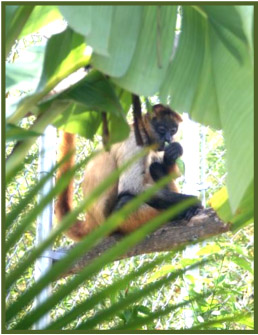
Carlos eating a leaf he foraged for 
in the new Spider Monkey Enclosure
Carlos and Montana were successfully moved into their new enclosures this last month!! Montana was quite comfortable entering the carrier, and was moved in first. A few days later, with some adjustments to the carrier crate, we were able to get Carlos in and take him up to join his brother. The two have been exploring their new enclosures, and look absolutely liberated in their new home. The Spider monkeys are enjoying all of the changes to their living environment. Carlos particularly likes foraging for leaves on the many plants, something he has never been able to do before! Montana has really gotten the hang of brachiating and has been nearly flying across the length of his enclosure daily.

Carlos and Montana stretch out on a platform!
Carlos and Montana’s new enclosure is fully assembled and open for their exploration! The final structure is 40 feet long, and filled with lush jungle plants, branches to brachiate across, ropes to climb and platforms to rest on. They now have a 360° view and can see the Bamboo grove, the orchard, the palms, and the ocean to the north. They seem to most enjoy stretching out, fully relaxed, on a high platform in the sun.


The new Spider Monkey Enclosure!

Farewell to Extern MC!
Deep appreciation and gratitude to Extern Mary Catherine for coming to Maui to be a 40-hour a week volunteer for a year! Thank you for contributing your expertise, compassion, for your willingness to be of service, and for passing on the knowledge you have gained over the last year to the new Interns and Volunteers.

Thank you for sharing positive reinforcement training with the volunteers and making life more interesting for the monkeys. (You say “foot?” politely and Miracle gives you her foot!) FAREWELL! We will miss your positive outlook, your gentleness, and dedication to the monkeys.
You have truly learned about and come to treasure each and every monkey at PPS. The monkeys have been so fortunate to have you caring for them. Thank you for creating the valuable Quick Reference Guide to the Monkeys. This descriptive summary of all of the monkeys’ medical histories is a wonderful resource and teaching guide and will be an amazing asset for years to come.

Extern MC’s Leaving Letter:
MC sharing videos of the monkeys at the
2010 PPS fundraiser
Of all the years that have rolled by in my life, I’m finding this year I’ve spent at PPS to be the hardest one to see end. Memories of the year resonate inside me and rage at its conclusion. Like a stubborn child at a fair, I do not leave here willingly. What good is a morning that doesn’t begin with walking into the corridor and saying, ‘good morning, my little menehune!’ My mornings here always began that way, followed by taking Iktomi and Leticia’s sheet down and seeing Iktomi’s expression that would tell me how he was feeling that day.


What is a day that doesn’t include hearing Leticia’s silly noises she makes at Lazero and Anna when she is eating a tasty treat? Each individual monkey here has touched me daily with their distinctive personalities and created for me a life sublime… My days at PPS are filled with small moments of enormous meaning, and I have a lifetime of memories to carry with me….


These monkeys have shared with me moments of divinity that will accompany me for the rest of my days. The opportunity has been life altering. I hope, as I leave PPS, the legacy of love and the unique lives of each individual monkey continue to be honored and kept precious in the minds and hearts of all who care for them. Thank you to everyone who cared for the monkeys with me. I am astounded by the dedication each one of you have to these divine beings. Much love and respect to all the primates here, big and small.


Welcome to New PPS Extern, Dawn
Pacific Primate Sanctuary is pleased to announce the selection of our June 2011-2012 Extern, Dawn. She is leaving her business, selling her car, and moving to Maui from Cheshire, United Kingdom in order to volunteer her time here at PPS!

As a full time Volunteer, Dawn will be carrying out the same duties as our Resident Interns, and will be given the opportunity to become a Primary Animal Caregiver. Caring for primates will be a new experience for Dawn, who has been working in marketing for many years. She says: “ This would be a complete change of direction for me, but I feel certain that it is the right thing to do at a time when I have taken stock and find myself drawn toward a more meaningful way of life, with the ability to help others to have a better life too.” We are very excited to have Dawn join us and contribute to the growth of PPS.

In her letter of acceptance Dawn writes:
I would like to thank you for giving me this amazing opportunity and therefore please do take this as my acceptance of your very generous invitation to join you as an Extern at the Sanctuary.


I am extremely honoured and proud to have been selected for this post, and my main objective now is to become immersed in every aspect of the role, contributing to the already very professional, dedicated and caring team.


The idea of working with primates has been a lifelong dream for me and although I am starting on a completely new path fairly late in life, I have no regrets because in my heart, I know that this is the right time for me.


My plan is to work hard and learn from the wealth of experience I will be exposed to, but also put to good use my own skills to help raise the profile of PPS and in doing so, add to the life quality of the monkeys. I look forward to meeting the Sanctuary Volunteer family and becoming a part of this very special place.


Farewell to Dr. Elizabeth Lyons, who is retiring from her position as Federal Veterinary Inspector for Hawaii, Alaska and Guam.
Betsy Lyons at PPS

Dr. Lyons has been a true friend and advocate for the animals. She was instrumental is ending the sale of baby monkeys to tourists in Lahaina and helped relocate the squirrel monkeys from a bar in Honolulu to the rainforest zoo on the Big Island. Betsy Lyons supported Lucy in finding homes for the 25 primates at the defunct Maui Zoo, in getting the Spider monkeys to PPS, and in passing regulations making it illegal to have primates as pets in Hawaii, which we spent decades lobbying for.

On her first inspection visit to PPS, many years ago, Dr. Lyons was seen standing in the corridor, looking up at the monkeys and weeping. When we asked why she was crying, she said that she was witness to how primates were being treated in the places she had to inspect and the contrast in how the monkeys at PPS were cared for, moved her to tears. She did her final official inspection of PPS last week, saving our Sanctuary for last. Thank you Dr. Lyons for your open heart; we know you will always have Aloha for the animals!


PPS goes to Roots School
Operations Manager Erin and Intern Olivia went to Roots School to present our environmental education program, “Be a Primate Pal”. The group consisted of 16 students between 4th and 7th grade. The children were very involved with the presentation, answering questions with thoughtful responses and asking some wonderful questions of their own. They particularly enjoyed seeing two videos, Pacific Primate Sanctuary’s “One Day on Earth” as well as “Prospero’s Etrog” (you can view these videos on youtube: http://www.youtube.com/user/pacificprimate). Erin and Olivia were thrilled to have such an enthusiastic audience!

Intern Olivia writes about the presentation:
Education is fundamental in the development of any species. Specifically, in humans, we learn through imitation. Until we get a formal education, we learn to talk, by making similar sounds to those of our parents and siblings. We learn to eat by implementing instruments, in a similar manner to our dining companions; and we learn to write by copying the letters in the alphabet. It is time to introduce environmental education into the formal aspect of education, as the actions of the current general population are not what we want the next generation to imitate. The coming generations need to learn to be conscious of their energy consumption, and what types of habitat destructive products are used i.e. in their soap, shampoo, and candy bars. They need help in figuring out ways to have a positive impact on the earth instead of just reaping all the benefits from it. This is where environmental education programs come in, specifically the one presented at the Roots school on June first.


The educational session presented by Erin and Olivia at Roots was designed to open the students’ eyes about primate conservation, specifically with regard to captive primates in the United States, ranging from the entertainment and pet industry, biomedical research, and primates in zoos and sanctuaries.


The different species at Pacific Primate Sanctuary were discussed including the Critically Endangered Cotton Top Tamarin (IUCN, 2010), and the Endangered Geoffroy’s or Black-handed Spider Monkey (IUCN, 2010). We asked the students to list some of the reasons for the threatened condition of these two species and the children had really good answers. They brought up habitat destruction, and capturing the monkeys for human entertainment and research purposes.


We discussed Capuchin monkeys, primates frequently used in the entertainment industry. The class was informed that by watching movies exploiting and ridiculing primates, or buying greeting cards and mazgazines with monkeys dressed in human clothing, they are supporting this industry. This has a negative impact on individual primates, who are often taken from their mothers at a young age and abused into doing tricks that are unnatural for them to perform.


The students learned about White-tufted Eared marmosets, Black-tufted Eared Marmosets, and Weid’s Marmosets, particularly their ability to use specialized teeth to get gum exudates out of trees. Unfortunately, because of their small size, these monkeys are very popular in the pet trade. We talked about the damage that occurs from monkeys being kept as pets, which is evident in some of the individuals here at the Sanctuary who have difficulties adjusting to life with other monkeys.


We ended by talking about different things that the children could do to contribute to conservation and animal welfare issues, and decrease the negative impact they have on the earth. Not consuming products with palm oil would play a huge role in decreasing deforestation. This group was too young to know where building materials come from, but it is important to be aware of where they are imported from, and avoid buying furniture made from hard woods, as these are taken from the rain forests where primates live. Also presented during the talk were ways to prevent the abuse of animals in the entertainment industry: avoid supporting entertainment companies that are known to mistreat animals. Finally, never purchase monkeys as pets, because living with humans is an unnatural environment for the monkey, and these animals may even have been captured from the wild.


Helping the Monkeys
Thank you to Kara, Intern Simon’s wife, for volunteering her time to help the monkeys while she was on vacation. While here, she mended hammocks, helped with observation of the monkeys, and created wonderful new enrichment devices. Lazero, a Cotton Top Tamarin really enjoys the coconut feeder that Kara fashioned. He hangs upside down on a rope to open the top half of the coconut and feast on the yummy treats inside. Kara also created a wonderful bamboo bridge. Hector and Persephone, two Cotton Top Tamarins are thrilled with the bridge, and spend much time sitting on it!

Thank you to Ryan for coming in to help at PPS while visiting Intern Simon. Ryan also created a bamboo bridge, which was placed in Echo and Apollo’s enclosure. This will be very helpful in allowing these two monkeys with mobility problems more access to their greenroom!

If you are interested in becoming one of Pacific Primate Sanctuary’s Angels, and volunteering your time and skills please e-mail us at: pps@aloha.net


How to Donate Directly
We deeply appreciate your continued partnership. You, and your family and friends, can make tax-deductible donations to the Sanctuary on our Website: www.pacificprimate.org and on FaceBook, using PayPal, or by sending a check to:


Pacific Primate Sanctuary
500-A Haloa Road
Haiku, HI 96708

With your support, you make everything we do possible!


PPS INTERNSHIP

Resident Internship Grants
Current PPS Extern and Interns:
 Mary Catherine, Olivia and Simon
Thank you to two generous donors for supporting our Internship Program! The Resident Internship Program at Pacific Primate Sanctuary began in 2004. We have had 23 Interns over the past 7 years and the curriculum has deepened and expanded over time. This mutually beneficial program has provided a unique and valuable learning experience for the Interns, and exceptional animal care for the primates at the Sanctuary. The Sanctuary could not operate without the Interns. These generous contributions will sustain this wonderful program and allow us to continue to offer housing, utilities, and supplies to our Interns. We are deeply grateful to our wonderful donors for partnering with the Sanctuary in providing a resident Internship program. They help to make our dreams a reality!


This Blog and its content is copyright of Pacific Primate Sanctuary, Inc.—

© Pacific Primate Sanctuary, Inc., 2009. All rights reserved.
Any redistribution or reproduction of part or all of the contents in any form is prohibited other than the following:
you may print or download to a local hard disk extracts for your personal and non-commercial use only
you may copy the content to individual third parties for their personal use, but only if you acknowledge the website as the source of the material
You may not, except with our express written permission, distribute or commercially exploit the content. Nor may you transmit it or store it in any other website or other form of electronic retrieval system.

Primate Update E-Newsletter, Vol. 3, Issue 6, Part 3


CONTINUING EDUCATION


Special Topic- Intern Olivia
Capuchin Development

Capuchins go through similar stages of development as other primates. Gestation is about five months, and the newborn baby is inspected by its mother at birth and treated with cautious interest by others in the group. A phenomenon called allonursing occurs in capuchins. This is when the infant nurses from any lactating female. An infant will begin to seek out other lactating individuals more frequently as their own mother begins the weaning process.

Capuchin young must learn which foods 
are safe to eat by observing adults.  
Young Viola watches Miranda eat a fig.
As the infant grows up they begin to learn to feed themselves and manipulate objects, so just after a year old they can be weaned. The young capuchin is completely nutritionally independent by their second year. This means that they have a year between weaning and when their mother cuts them off in which to learn which foods to eat, where to find them, how to access them, and how to avoid predators. Younger capuchins do not have the same physical strength or the same mental capability for determining what to eat as adults do, and this often results in starvation of the young capuchin. Those that survive have developed faster than those that do not, and their children will be more likely to survive to sexual maturity because of their ability to forage for food. Foraging is not the only development the capuchin must go through, but it is the most essential to their survival.

Capuchin young observe and participate in play activities so that when they get older they will be prepared to defend their territories and protect their families and themselves.

There is also sexual play occurring before the time of sexual maturity. With females this begins about age four and for males around age three. This can be different sexual activities, such as mounting, where everyone participates in mounting and being mounted. Female sexual play ends at the age of sexual maturity when their interest in the opposite sex arrives, and they put the sexual play to good use.

Behavioral development is as important, or even more important, than physical development. By the time an individual is large enough that the mother is going to stop breast-feeding, he/she has to know how to forage appropriately or he/she will starve, as others in the group will no longer help them determine what to eat or how to get at good foods. They do need the jaw formation to bite into some of these foods, but as long as they have a wide range of knowledge of the different foods, they will not starve.

Other social behaviors, such as learning the difference between play and aggression and how to use brute strength to defend your food source and your family are very important as capuchin’s social structures are very complex. They need to learn the difference between sexual behavior and certain play behaviors so they know how to solicit a mate for reproduction. Play gets confused with many other behaviors, because juveniles use play to learn what these behaviors are and how they will be used in the future.

Capuchins get old, but remain active socially and physically and can live well into their forties, as long as they’re healthy. Females experience longer inter-birth intervals as they age, but there is no conclusion as to whether or not they go through menopause.

-Fragaszy, D.M., Visalberghi, E., Fedigan, L.M. (2004) The Complete Capuchin: The Biology of the Genus Cebus. UK. Cambridge University Press


Special Topic-Extern MC
Chapter 9: Social interactions, social relationships and the social system of Spider monkeys

Spider monkeys have a fission-fusion social system characterized by a constantly changing group size as subgroups merge and separate throughout a day. This social system is thought to be a means of coping with sporadically distributed food sources because it reduces feeding competition between individuals of the same community. Depending on the local availability of food, spider monkeys will forage for food in small subgroups when food is scarce, and larger subgroups when food is plentiful. However, unraveling the social relationships of spider monkeys is not so simple and researchers are just beginning to discover the complex world of their social lives.

Females are often found foraging on their own or in very small subgroups, especially if they have dependent offspring. The common theory for their preferred small subgroups suggests female spider monkeys forage this way in order to save in travel costs. Groups with more individuals must visit more feeding sites to satisfy everyone’s hunger, thus expending more energy. Smaller groups need to visit less patches of food, thus travelling less and saving in energy expenditure. This is especially important to a female carrying an offspring. A consequence of foraging alone or in small groups is the lack of development of strong social bonds between females.

Less grooming and other affiliative behaviors between females have been reported by many studies of wild spider monkeys. Interestingly, embraces and grooming interactions increase between females when one has an infant. The author suggests that because female primates are strongly attracted to other females’ infants, an individual without an infant will offer grooming to a female with an infant in order to gain access to the baby. Aggression between females is rare, though because female spider monkeys leave their natal group when they are reproductively mature, leading females sometimes show aggression to new females immigrating into their community.

Unlike relationships between female spider monkeys, relationships between males are very strong. Within a social community, interactions between males are overwhelmingly affiliative. Grooming, embracing, and pectoral sniffing (a species typical affiliative behavior) are interactions most commonly seen between males. Males often forage in larger subgroups and often travel together to the boundaries of their home ranges on “patrols.” They have even been observed walking on the ground in single file deep into territory of neighboring communities in order to carryout “raids” in which they display and often chase members of the rival group. The strong social bonds between males foster the trust and cooperation necessary to carry out such dangerous endeavors. Observations of wild spider monkey communities show very low levels of aggression between males, although lethal aggression has been witnessed and may be more widespread than originally thought.

Montana comes in close to share an embrace with his brother, Carlos
Relationships between male and female spider monkeys are described in this chapter as intermediate between male-male and female-female relationships. Grooming and instances of embraces occur more frequently between a male and female than between females, but less frequently than it does between males. However, very strong bonds are found between a mother and her adult son. The most instances of aggression in a spider monkey community are by males being aggressive toward females. A possible explanation is that because spider monkeys are not sexually dimorphic (in other words, no size difference exists between the sexes), the aggression exhibited by males to females are “intimidation displays” in which males attempt to dominate equal sized females. This chapter stresses the need for further investigation into the complex social lives of spider monkeys before more definitive conclusions on their social structure can be made. With increased conservation efforts, wild spider monkey culture will be preserved and determined primatologists can delve further into the fascinating social world of spider monkeys.

-Campbell, Christina J. Spider Monkeys: The Biology, Behavior, and Ecology of the Genus Ateles (Cambridge Studies in Biological and Evolutionary Anthropology). UK. Cambridge University Press. 2008.


Special Topic- Intern Simon
Habitats, feeding ecology, and home range size in the genus Callithrix; by Anthony B. Rylands and Doris S. de Faria

**NOTE** The taxonomic classification has changed since the writing of this article. The genera Mico and Callibella were once considered to be part of Callithrix, but are now classified as distinct. Please note that when this article speaks of the genus “Callithrix,” it is actually referring to all three of the different genera. For the purpose of this summary, I shall simply use the term “marmoset,” but exclude the pygmy marmoset (of the genus Cebuella) from this usage.

Introduction
Marmosets are found in Brazil, the northeastern tip of Paraguay, and eastern Bolivia. The relatively wide distribution of the various marmoset species is indicative of the wide variety of habitats that they occupy. Each species is unique—a result of their adaption to their own specific habitat—but there are strong similarities as well. This article gives a general summary of these similarities and differences.

Habitats
The various habitats that marmosets live in include evergreen forests, seasonal semi-deciduous forests, Amazonian-type savannas, white sand forest patches, tall forests with dense undergrowth along waterways, lowland forests, and highland forests. Some live more inland and some are coastal. Clearly, these are all very different kinds of forests. But although they occupy this wide range of habitats, one similarity among all the different marmoset species—regardless of the type of habitat they live in—is their preference for secondary forests.

A secondary forest is a forest that has been regrown after a major disturbance (for example, after a fire or after severe logging). In a secondary forest, the effects of the disturbance are no longer noticeable. So why would marmosets choose to live in a regrown forest rather than an old-growth primary forest? It all has to do with the fruit types and fruiting patterns of the “pioneer plants” that only grow in secondary forests. Also, secondary forests are denser than primary forests, providing better shelter. Not to mention the fact that secondary forests are loaded with tasty creepy-crawlies that the marmosets can munch on…which brings us to the next point.

Feeding Ecology
Davis and Cordelia search for ants and sweet nectar 
among the petals of this pink ginger flower
Bugs might sound like an unpleasant choice of food, but they are high in protein. Marmosets also hunt other small prey as well, such as spiders, snails, frogs, lizards, and even small birds on rare occasions. In fact, animal prey makes up about 25% of most marmosets’ diets. The other 75% depends on the species. In addition to being insectivores, they are all fruit eaters (frugivores) and gum and sap eaters (exudativores) as well. But some marmoset species rely predominately on exudates, with a supplemental fruit here and there, and others are just the opposite. For example, White-tufted and Black-tufted marmosets are predominately gum and sap eaters, eating very little fruit in the wild, while Weid’s marmosets (such as PPS’s own Davis) are highly frugivorous. But regardless of how often they eat saps and gums, all marmosets are evolutionarily adapted to do so. In fact, marmosets are the only primates that have this adaption. Their long lower front teeth and their intestinal shape are specifically designed to gouge tree trunks, branches, and vines and digest the gummy goodness. But because extracting sap is an energetically costly activity for these little marmosets, fruit is often preferred when it is available. But remember, different marmoset species live in different habitats, and some of these habitats are more bountiful with fruit than others. Going back to the example of Weid’s marmoset: they are highly frugivorous, probably because they are predominately found in evergreen forests where fruit is plentiful. White-tufted marmosets, on the other hand, tend to live in highly dry thorn scrub where gums abound but fruit is scarce. So while marmosets all consume the same things, the percentage of the food items consumed depends on the availability of that food in the habitat where the species is found in.

Range Size
The ranging distance of marmoset species corresponds to the presence (or absence) of fruit. For example, recall that White-tufted marmosets usually do not have an abundance of fruit in their habitat so they mostly eat gums and saps. Well, because gums and saps are ever-present, White-tufted marmosets do not have to travel far, and therefore have a small range (only .5 between 6.5 hectares), as does the Black-tufted marmoset (1.25 to 4.5 hectares). In contrast, Weid’s marmoset has a range about twice that (between 10 to 12 hectares). This is because, the Weid’s marmoset prefers fruit, and fruit tends to be more widely dispersed than gums. Marmosets of the genus Mico have relatively smaller lower incisors and so are biologically less adept at extracting gums and saps than Callithrix marmosets and subsequently have a much wider home range.

Conclusion
As we have seen, habitat, diet, and home range are all inter-related. For example, since the White-tufted and Black-tufted marmosets excel at gouging saps (their diet), they are able to thrive in the most unfavorable environments (their habitat) and they travel less (their home range) because the gums are found everywhere. How the different marmoset species have reconciled these three factors of habitat, diet, and home range has created differences and diversity among them.

But while marmosets vary greatly from species to species, they share common features. Regarding their habitat and diet, the common features include their dependence on secondary growth or disturbed forest; their ability to extract gums when faced with permanent or seasonal shortage of fruits, and their methods of foraging for animal prey. These shared traits, contrasted with their differences, create an appreciation for the diversity among marmosets.

-Rylands, A.B. Marmosets and Tamarins. Systematics, Behavior, and Ecology. Oxford, U.K.: Oxford University Press, 1993.


Animals are not brethren, they are not underlings; they are other nations, caught with ourselves in the net of life and time. 
— Henry Beston


We hope you have enjoyed this issue of Pacific Primate Sanctuary’s E-Newsletter. Thank you for your support of our life saving work. Because of compassionate people, the Sanctuary can continue to provide a place of peace and happiness for 74 primates saved from research laboratories, animal dealers, and smugglers. Here they can heal, form families, and live free from exploitation.


This Blog and its content is copyright of Pacific Primate Sanctuary, Inc.—
© Pacific Primate Sanctuary, Inc., 2009. All rights reserved.
Any redistribution or reproduction of part or all of the contents in any form is prohibited other than the following:
you may print or download to a local hard disk extracts for your personal and non-commercial use only
you may copy the content to individual third parties for their personal use, but only if you acknowledge the website as the source of the material
You may not, except with our express written permission, distribute or commercially exploit the content. Nor may you transmit it or store it in any other website or other form of electronic retrieval system.

Friday, May 13, 2011

Primate Update E-Newsletter, Vol. 3, Issue 5, Part 1


PPS PRIMATES in the SPOTLIGHT

We grieve the passing of two very special monkeys this past month.

Solomon, a Black tufted eared marmoset, passed away on April 16, 2011. He lived large and loved food, sharing his life with a companion, sitting on a branch outside with the sunshine on his belly. He was inquisitive and excited by new experiences. Just a few weeks ago, the Interns blew soap bubbles for him and he watched in amazement.

When we buried him, we remembered his parents, Florence and Tank. Florence was confiscated from smugglers in New York and was sent, with her sister, to the Sanctuary. Solomon’s father, Tank, came from the discredited laboratories in New York as an older, down trodden man. His story is on our website. Florence, who was a much younger monkey, and Tank had an amazing relationship and a wonderful family.

As we finished the telling of his story, circled around his small grave, we asked that Solomon commend us to those who went before and tell them that there ARE people in the world whose hearts are filled with love for them.


Lucian was born on October 23, 2002, at a testing facility has been cited repeatedly by the USDA for Animal Welfare violations. After spending two years there, Lucian, his parents and seven siblings were sent to Pacific Primate Sanctuary. A veterinarian who was working at the laboratory wanted to send at least one family of marmosets to Pacific Primate Sanctuary before she quit her job at the facility.

Lucian and Olivia
Lucian was paired with Olivia, a marmoset who was human reared, after her mother died in childbirth. Olivia learned much from Lucian about how to be a monkey, including normal behaviors and vocalizations. Their lives became complete when they had children. Lucian and Olivia were wonderful parents, always protective of their family. Over time, their offspring grew up and found companions of their own. Lucian and Olivia both developed health conditions requiring specialized care, and one or the other would often spend time in the infirmary being gently nursed back to health in the tender hands of their caregivers.

Lucian and Olivia 
observe holiday candles
Each time Olivia was taken to the infirmary, Lucian would wait for her return. During these times of separation, we would often place Olivia in a kennel in front of Lucian. Lucian would always come running as soon as he saw her, and spend the whole day close by, keeping a careful watch over Olivia. At night, he would wait to go up to his sleeping house until his mate was put to bed and sleeping peacefully. Over the last several weeks, Lucian’s health deteriorated rapidly and he passed away on April 26, 2011.

Solomon and Lucian were both dearly loved by the many caregivers who were fortunate to know them, and will be greatly missed.

Please help us continue to provide monkeys such as Solomon and Lucian with a home where they can pass their days in peace and gladness.
Donate now at http://www.pacificprimate.org/help-donate.htm


SANCTUARY NEWS

Please Join us in Celebrating Miranda’s Life!
Miranda upon Arrival
Miranda fives months 
after coming to PPS
Miranda arrived at Pacific Primate Sanctuary on May 17, 1990, rescued from a tourist attraction on Kauai. She had spent over a year living solitarily in a tiny 4’x4’ cage, with no room to move around or even stand upright. When she arrived, she was emaciated, had plucked all the fur from her arms, chest, neck and tail and was weak with atrophied muscles. By mutilating herself, Miranda was crying out for help against the injustice inflicted upon her. Here at PPS, she was given her life back. We built her a big enclosure, offered her lots of fresh fruits and vegetables, and treated her with kindness and respect. She loved to listen as her caregivers sang to her. Over time, her muscles grew stronger and her fur grew back. Miranda has now been at the Sanctuary for 21 years, and is thriving. As a wild caught monkey, we do not know Miranda’s date of birth, so instead we celebrate Miranda’s life each year on May 17- the day she found a caring home at Pacific Primate Sanctuary


Cotton- top Tamarin, Nadine, gave birth to twins on April 4th. One of the infants was extremely weak during the first few days, and strained to hold tight to mom’s back. When caregivers saw this struggle for life, they offered extra support- dropper feeding the tiny infant, and providing warmth. Soon the baby’s strength increased, and he was able to cling tightly to Nadine’s back and nurse to maintain his strength.

This species is listed as Critically Endangered, and unfortunately the population is currently decreasing. When a species is listed as Critically Endangered, it is facing an extremely high risk of extinction in the wild. In fact, 80% of the total Cotton Top Tamarin population has been lost over the last 18 years. Pacific Primate Sanctuary is currently home to 22 Cotton Top Tamarins. Their survival provides hope for the future of this at-risk species.


Viola, a young Capuchin monkey sold her very first painting! Viola has been painting with tempera paints for over a year. She loves using her fingers to spread the colors around the page (and occasionally her face!). John, a PPS Supporter, was extremely moved by the video “Viola Paints”, on YouTube and on Pacific Primate Sanctuary’s Facebook page, and wanted to have one of her paintings. He offered a very generous donation for Viola’s Earth Day Painting #1.

Viola’s Earth Day Painting #1


This Blog and its content is copyright of Pacific Primate Sanctuary, Inc.—
© Pacific Primate Sanctuary, Inc., 2009. All rights reserved.
Any redistribution or reproduction of part or all of the contents in any form is prohibited other than the following:
you may print or download to a local hard disk extracts for your personal and non-commercial use only
you may copy the content to individual third parties for their personal use, but only if you acknowledge the website as the source of the material
You may not, except with our express written permission, distribute or commercially exploit the content. Nor may you transmit it or store it in any other website or other form of electronic retrieval system.

Primate Update E-Newsletter, Vol. 3, Issue 5, Part 2


WHAT’S HAPPENING at PPS?

Spider Monkey Enclosures
Montana contentedly eating breakfast in his new home!
The Spider Monkey enclosures are all set up and ready for Carlos and Montana. Montana has already been moved and is happily exploring his new space!

Montana entered the carrier easily and we were able to relocate him to the new enclosure in a stress-free way. Carlos has been more wary of the carrier, and we are still working with him on entering so we can move him in with his brother.

2009-2010 PPS Intern Alli recently wrote to us:
I was just thinking about Pacific Primate Sanctuary because I was watching Discovery Channel and they had a show where they were re-locating 25 Capuchin monkeys from a closing sanctuary to a primate sanctuary in Florida. The way they were capturing the monkeys just broke my heart. The monkeys were screaming while being chased into cages and netted and were so afraid of all the people and nets and suits that one of the mother monkeys actually rejected her baby after. It made me think of the stark contrast to how you... have dealt with having to move Carlos and Montana and how patient and loving you are toward them. I really appreciate the way PPS is run and the fact that everything is there for the monkeys … I know these people's hearts were in the right place but I just wish they knew that there was a kinder way….

Volunteers
We would like to welcome our two newest volunteers, Charlene and Laurie! Charlene has joined us for the Tuesday and Thursday a.m. shift, as well as the Saturday p.m. shift, becoming a very committed and appreciated Sanctuary volunteer! She has worked with a variety of animals including horses, guinea pigs, cockatiels and turtles but this is her first time working with primates. She is eager to learn and extremely helpful and industrious. Laurie is now volunteering for the Wednesday a.m. shift. She has volunteered in the past with a local farm sanctuary. She is very compassionate and excited to be at PPS.

We would like to congratulate Volunteer Katie on graduating from her Emergency Care training, and becoming a fully trained Animal Caregiver Volunteer!


HELPING THE MONKEYS

Pacific Primate Sanctuary’s Family
Director, Lucy, spends every day in the office recruiting new Interns, finding financial support, responding to countless e-mails and always offering advice and guidance. Operations manager, Erin Marie, provides her invaluable support at the Sanctuary, in the office, working with the veterinarian, and picking up food and supplies in town.
Sanctuary Interns, Olivia and Simon and extern Mary Catherine, give devoted care to all of the animals each day, maintain their home, and contribute their insights and ideas towards improving the Sanctuary. PPS Volunteers: PPS V.P. Dr. Bud, Charlene, Judi, Anne and Morgan, Jonathan, Katie and Laurie make time each week to keep all of the monkeys cared for, and the enclosures and the facility kept clean, pruned and outfitted.

Steven builds the monkeys’ homes and makes repairs and improvements to their enclosures! He, and new volunteer Nick, have created 20 protective wire grates for the outdoor Green Rooms.

PPS Treasurer, Linda, does the monthly bookkeeping prepares our taxes, and drafts the yearly PPS Budget. Jennifer, the Secretary on our Board of Directors, writes up minutes for each Board Meeting. Dr. Dressler and Dr. Delaney, provide their expertise, advice, feedback, and veterinary care to the monkeys.

The PPS Family keeps the Sanctuary functioning. Because of their contributions we can continue to offer threatened primates a place of peace and healing. They exemplify compassion, generosity, and that rare quality of selfless service, which shines a light— dispelling a great darkness. They are doing the work of Angels!

If you are interested in becoming one of Pacific Primate Sanctuary’s Angels, and volunteering your time and skills please E-mail us at PPS@aloha.net

Joani, Visiting the new
 Spider Monkey Enclosure
The donors and friends of Pacific Primate Sanctuary make generous contributions towards the construction of new enclosures, funding the internship program, and subsidizing the feeding and care of over 70 primates. Generosity and compassion are the stuff miracles are made of; please become one of the Sanctuary’s Miracle Workers.


How to Donate Directly
We deeply appreciate your continued partnership. You, and your family and friends, can make tax-deductible donations to the Sanctuary on our Website: www.pacificprimate.org and on FaceBook, using PayPal, or by sending a check to:


Pacific Primate Sanctuary
500-A Haloa Road
Haiku, HI 96708

With your support, you make everything we do possible!


PPS RESIDENCY

Pacific Primate Sanctuary’s Residency program is a unique immersion experience. During the first portion of the Internship, new trainees learn to provide daily care to the 73 monkeys at the Sanctuary. This includes preparing diets, administering daily medications, providing enrichment and maintaining the enclosures as well as the Sanctuary facility.
Once an intern has successfully grasped this information, he/she moves on to the next phase: Emergency Care training. Interns learn to provide special individual care to monkeys in need. During this time an Intern really begins to hone their observational skills, learning the individual monkeys in order to be able to tell when one is not feeling well. Interns are trained in how to handle emergency situations; administering subcutaneous fluids, using an incubator, wound care, checking vital signals and calculating drug dosages. Our newest Intern, Olivia, who arrived in March, has recently completed her Emergency Care Training and is well on her way to becoming a fully trained Resident Intern!

The third training module involves Sanctuary management. PPS Interns learn the skills necessary for Colony management (pairing new monkeys, movements within the corridor, etc). Knowing each individual monkey is vital to this aspect of the Internship. Interns also train and oversee other volunteers, create and update protocol documents and keep detailed records of all the primates at the Sanctuary.

Simon and Mary Catherine work 
together to set up an enclosure
Once an Intern has become proficient in all these areas, they are awarded Primate Animal Caregiver status by senior staff. We would like to congratulate Intern Simon on completing his training, and becoming our newest Primary Animal Caregiver! However, the learning process never truly ends and Simon is now deepening in his role as an Intern at PPS. This is happening at just the right time, as our current Primary Animal Caregiver, Extern Mary Catherine, will be completing her externship in June. Over the next month, Mary Catherine will focus on passing down all the information and wisdom she has gained during the last year to Interns Simon and Olivia. This will ensure that, while Mary Catherine may not be here physically, she will always be present for the monkeys and the PPS caregivers in the documents she created and the knowledge she will leave behind.


This Blog and its content is copyright of Pacific Primate Sanctuary, Inc.—


© Pacific Primate Sanctuary, Inc., 2009. All rights reserved.
Any redistribution or reproduction of part or all of the contents in any form is prohibited other than the following:
you may print or download to a local hard disk extracts for your personal and non-commercial use only
you may copy the content to individual third parties for their personal use, but only if you acknowledge the website as the source of the material
You may not, except with our express written permission, distribute or commercially exploit the content. Nor may you transmit it or store it in any other website or other form of electronic retrieval system.

Primate Update E-Newsletter, Vol. 3, Issue 5, Part 3


CONTINUING EDUCATION


Special Topic: Extern Mary Catherine

Chapter 8: Communication in Spider monkeys:
The function and mechanisms underlying the use of the whinny

Spider monkeys have a unique and fascinating vocal communication repertoire. Current research is exploring the vocalizations of spider monkeys in hopes of understanding what kind of information is communicated in their calls. As canopy dwellers, spider monkeys travel great distances through a complex environment in search of fruit patches. In order to communicate through the dense canopy, spider monkeys employ long-distance vocalizations as a means to locate group members, food, and avoid danger.

Spider monkeys have a fission-fusion society, meaning their social groups fracture into smaller subgroups (or even just individuals) and disperse throughout their environment to forage for food but join together again in the evening. Fission-fusion societies are found in animals with complex cognitive abilities related to building and maintaining social relationships. For example, dolphins, elephants, and chimpanzees all have fission-fusion social systems as well. Spider monkey communication is thus very intricate and we are still trying to understand the information conveyed in their calls.

Carlos often whinnies when 
eating his favorite treats!
Current research suggests two vocalizations of spider monkeys, the trill and the whinny, may contain information on the animal making the call. Whinnies appear to act as a food call, increasing in frequency when there is an abundance of food. Researchers suggest this may act as a way to let other group members know where food is available and possibly to lower predation risk through safety in numbers. Members of a subgroup often stay an average of 30 meters apart from one another while they disperse and forage, while different subgroups keep a distance of 170 – 370 meters from one another. Though they may be visually separated from other members of their group, a spider monkey whinny can be heard from 300 meters away in a typical habitat!

However, the whinny is not just a sound to alert conspecifics about food. The acoustic structure of whinnies has many variations that are thought to contain specific information on both the identity of the caller and the identity of the intended recipient. This allows spider monkeys to stay in contact with specific individuals throughout their day. Trill vocalizations are also thought to contain information about the identity of the caller. In fact, studies show slight variations in the auditory make-up of a call represent identities of each group member. In other words, these calls may act as labels in how they address each other… something similar to having names! Doesn’t it make you wonder what kind of whinnies Carlos and Montana have for each of us?

-Campbell, Christina J. Spider Monkeys: The Biology, Behavior, and Ecology of the Genus Ateles (Cambridge Studies in Biological and Evolutionary Anthropology). UK. Cambridge University Press. 2008.


Special Topic: Intern Simon


The ecology of the pygmy marmoset, Cebuella pygmaea: some comparisons with two sympatric tamarins; by Pekka Soini

Introduction
The word “sympatric” refers to different species that occupy the same geographic area. In this chapter the author focuses on pygmy marmosets—a species previously housed at PPS—and compares them with two other monkeys: the moustached tamarin and the saddle-back tamarin. PPS currently provides refuge for two saddleback tamarins: Gaia and Galatea. After a brief description of the pygmy marmoset, we will see how they coexist with the two tamarin species.


Description and Ecology of the Pygmy Marmoset
You can find pygmy marmosets in the upper Amazon lowland forests of Peru. As their name suggests, they are tiny. The average weight for an adult is 119 grams: less than the weight of the average hamster. They live in groups that range in size from 2-9, but on average a troop consists of about five individuals—typically one reproductive female, her mate, and their offspring. Even in cases where there are more than one adult female, only one will be reproductively active. When children become young adults they leave in search of a mate of their own. But new births—usually to twins—constantly occur every 5-7 months, replacing those who leave.

Pygmy marmosets are habitat specialists. They live in floodplain forests along rivers. They are nomads who prefer to stay put for as long as possible. Troops occupy a range of about half a hectare, but the actual size of a home range depends on the distance between the gum trees and vines that these monkeys depend on for food. They will find a tree that can support the group and vampire-ize it until it no longer produces enough sustenance to sustain the group, at which point it is time for the troop to uproot and find another food source. But until the tree has been sapped of its sap—which can take a few months to several years—the troop will make that tree their central territory, and most social interactions will play out around this home base.

Comparing the Pygmy Marmoset to Their Sympatric Relatives
While pygmy marmosets are highly specialized, their two larger tamarin brethren—the saddleback and the moustached tamarins—live a very different lifestyle. Rather than living on gums and saps, they have a more generalized diet of fruit and insects and will only eat gum or sap rarely as a dietary supplement when fruit is scarce. Though the pygmies have a small home range, the members of the group tend to spread out within that range, often foraging individually. In contrast, the two tamarin species have a much larger range—a consequence of relying on the availability of fruit—but will stick close together when on the search for food. Furthermore, for the tamarins their home range may be larger than the pygmy’s but it does not change. They are well aware of where the fruit trees are and when a given tree is producing ripe fruit. They perpetually make the rounds to where the ripe fruit is, knowing that when one tree has been exhausted they can return to it when it is replenished. In this way, they never have to leave the parameters of their home range. For the pygmy marmosets, when a tree has been exhausted they abandon it and will change their home range several times in a troop’s lifetime.

Saddlebacks are nearly three times the body mass of a pygmy marmoset and the moustached tamarin is nearly four and a half times larger. This has reproductive ramifications. The pygmy marmoset’s small size and reliance on a food source that is more stable than fruit allows them to produce offspring at a faster rate than the two tamarins. They are able to give birth every six months while saddlebacks take eight months and moustached tamarins take anywhere from eleven to twenty months. The smaller size of the marmosets also means that they can effectively occupy a smaller home range. The pygmies occupy a mere ½ a hectare, while saddle-backs have a home range of 16 hectares, and the larger moustached tamarins: 25 to 35 hectares.

Conclusion
As we can see, diet, body mass, and ranging patterns all inter-relate to one another and comprise the strategy that a species employs to be successful. Though all three of the aforementioned species are primate, each has adapted to its own unique niche so that they can all coexist in the some habitat. This helps support a stable ecological system.

-Rylands, A.B. Marmosets and Tamarins. Systematics, Behavior, and Ecology. Oxford, U.K.: Oxford University Press, 1993.


Special Topic: Intern Olivia Brown


The Capuchin Body

This chapter discussed the morphology of the Capuchin body and how it helps them function in the wild. The White-faced Capuchins, the species living at PPS, have pale skin on their faces that may darken with age. They also have black tails. Capuchins weigh about 2.7 kilograms, in the middle of the size range of neotropical primates.

The Capuchins’ hands, teeth, tail, and eyes function well with their large brain to body size to make them a successful species.

Viola uses her hands and teeth 
to get the sweet juice 
from sugar cane
Capuchins have a much larger brain to body size than that of other New World primates. It is more on the scale of old world monkeys. Capuchins use their large brains to forage for hard to find foods, they are omnivores but eat insects and difficult to get to fruits that are surrounded by hard shells, like figs, and fruits surrounded by spines. They use their brains to determine how they can use their teeth and hands using a precision grip similar to a grip found in old world monkeys, but not other neotropical primates.

Their eyes are very specialized and important in finding ripe fruit to eat. Within Capuchins there are several different types of color vision. They also have a greater sensitivity to see bright objects once their eyes have adjusted to the dark.

The Capuchin is considered a quadruped, and walks on all four limbs, using a prehensile tail as another hand. Some new world monkeys have a patch of skin at the end of the tail that has a more specialized skill, but the capuchins have hair to the tip of their tail. They use it for balance while walking on branches reaching for vines or other branches so they don’t fall.

The Capuchins also do a lot of grooming and enjoy grooming with citrus oils and other plant matter in the wild. Some of the objects they have been seen grooming with act as insect repellents, but they may just want to smell good. All four Capuchins here like to rub the oil from limes or etrog all over themselves, and Viola will continue to rub her body with her tail.

All of these specialized morphological features help the Capuchins survive in the wild. They can access food that other monkeys pass by. The use of an abundance of foods allows for a wider range and access of food in times of food scarcity. These specific features make them a very successful monkey.

-Fragaszy, D.M., Visalberghi, E., Fedigan, L.M. (2004) The Complete Capuchin: The Biology of the Genus Cebus. UK. Cambridge University Press


“No problem can be solved from the same consciousness that created it.
We must learn to see the world anew.” —Albert Einstein


We hope you have enjoyed this issue of Pacific Primate Sanctuary’s E-Newsletter. Thank you for your support of our life saving work. Because of compassionate people, the Sanctuary can continue to provide a place of peace and happiness for 74 primates saved from research laboratories, animal dealers, and smugglers. Here they can heal, form families, and live free from exploitation.


This Blog and its content is copyright of Pacific Primate Sanctuary, Inc.—
© Pacific Primate Sanctuary, Inc., 2009. All rights reserved.
Any redistribution or reproduction of part or all of the contents in any form is prohibited other than the following:
you may print or download to a local hard disk extracts for your personal and non-commercial use only
you may copy the content to individual third parties for their personal use, but only if you acknowledge the website as the source of the material
You may not, except with our express written permission, distribute or commercially exploit the content. Nor may you transmit it or store it in any other website or other form of electronic retrieval system.