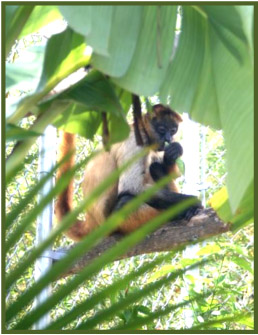
Thursday, August 18, 2011

Primate Update E-Newsletter, Vol. 3, Issue 8, Part 2

WHAT’S HAPPENING at PPS?

Farewell Anne and Morgan
Mother/daughter team Anne and Morgan has been volunteering at Pacific Primate Sanctuary for the last three years. Additionally, the third member of the family, Chip, has come in to volunteer when his daughter, Morgan, was unavailable. This wonderful family has been such a valuable addition to the PPS team. With their busy school and work schedules, they have found it increasingly difficult to find the time to continue volunteering. Sadly, they will no longer be volunteering on the Sunday PM shift during the school year. We will miss their positive energy and bright smiles. However, they are planning on coming back during school breaks, and we greatly look forward to seeing them!

Anne writes:
The Sanctuary has been such a special and important part of our lives for the past three years and we feel very blessed, honored, and humbled by the experience. It is with great sadness that we temporarily say goodbye… Thank you so much for allowing us to be apart of this wonderful service and thank you for all that you do! To the Monkeys we say: thank you for the incredible beings you are, for the joy you have brought to our lives, and for all you have taught us!

We hope to see you back again soon Anne and Morgan!


Helping the Monkeys
We are currently in need of more local volunteers! If you live on Maui and are interested in becoming one of Pacific Primate Sanctuary’s Angels, and volunteering your time and skills please e-mail us at PPS@aloha.net. We are looking for Animal Caregiver Volunteers, as well as Office Assistants, Handymen, and Gardeners/Landscapers.


How to Donate Directly
We deeply appreciate your continued partnership. You, and your family and friends, can make tax-deductible donations to the Sanctuary on our Website: www.pacificprimate.org and on FaceBook, using PayPal, or by sending a check to:

Pacific Primate Sanctuary
500-A Haloa Road
Haiku, HI 96708

With your support, you make everything we do possible!


PPS INTERNSHIP

We bid a fond farewell to Intern Simon who has completed his Internship, and is headed off to get his Masters in Primatology at Oxford Brooks University. Simon has made many valuable contributions including: passing on the knowledge he gained at the Sanctuary to our newest caregivers, Dawn and Caroline, creating a Geriatric Monkeys care document and a Special Medications Inventory list, which will help future Interns and Volunteers to be better caregivers.

Simon’s Farewell
… when I think about my service here one thing is clear: my experiences have been tremendously rewarding. From training in emergency care, to learning how to dice up Jack Fruit, I was constantly learning new things. But the rewards of this internship go beyond mere knowledge. I was introduced to some of the most selfless people you could ever hope to meet. And let’s not forget the marvelous monkeys who give us all a sense of purpose. It has truly been an unforgettable experience.


… even though all of my academic training has taught me never to anthropomorphize, whenever I see Leticia grooming her crippled mate, Iktomi—even though she must know full well that he can never reciprocate the favor—the only explanation I am left with is that she does this out of unconditional love. This pair never ceases to amaze me. Iktomi is one of the first monkeys to capture the affection of his caregivers, due to his condition and his gentle demeanor. But Leticia deserves credit too for being such a dedicated mate, and for tolerating the smaller enclosure even though she is completely able-bodied. I was absolutely delighted to see these two finally move in to their new double-sized enclosure, just as my internship drew to its close. Watching Leticia adventurously scamper about from branch to branch while Iktomi puttered around on his platform level was utter euphoria to witness. And I’ll never forget the day Dawn and I took Iktomi out for his first session outside in the shady grass, boundless blue skies overhead.


Then there was the moment when the new Spider Monkey Enclosure was completed and we finally—after months of failed attempts—had moved both Montana and Carlos in. It took so long to capture them for the move because the PPS method was to use a slow-going strategy that minimized stress. Our patience finally paid off. Once moved, watching them brachiate from one side of their expansive new home to the other was remarkable. To see them come alive in their new world—more than triple the size of their old one—was a glorious sight to behold.


I recall the day the Cotton top tamarin babies were born, two fuzzy…little monkeys with slicked back hair… And how later that day Mary Catherine, Olivia, and I found one of them on the ground, cold, and seemingly lifeless. I scooped the baby up and we prepared baby formula for her, which she ravenously gulped down. After a spell in the incubator she was completely restored to normal. When I grabbed her to take her out and return her to her family she instinctually wrapped around my finger and clung like some sort of miniature woolly salamander clinging to a twig, eyes like big black prayer beads. It was such a surreal moment. And then to see her be welcomed back by her family upon reintroduction, I was humbled to be witness to this act of—dare I say it—humanity…


If it were just me and the monkeys that would have been a fully rewarding experience in and of itself. But there was also the rest of the PPS team. There is such a high concentration of unadulterated good people at PPS and every single one of them continually inspire me.


… This sincerely has been a monumental experience. My reflection on this experience has convinced me of just how much I’ve learned here, both professionally and personally. Now I am armed with the necessary experience I sought out in order to create my own sanctuary. I can only hope that I was able to give to PPS at least a minute fraction of all that it bestowed upon me. I am going to deeply, genuinely miss the primates at PPS—both those with tails and without. Thank you, fellow primate custodians. To say it has been a pleasure would be an understatement. Let me close by saying my hope is that this isn’t really the end of my internship, but rather the beginning of a lifelong collaboration between PPS and the sanctuary I aspire to build.

Introducing Linda, Our Newest PPS Intern:
We are very pleased to announce the arrival of Resident Intern, Linda! She has been here for a week now, and has shown great enthusiasm in her training.

In her acceptance letter, Linda writes:
It is with great excitement that I accept this internship position at PPS and the opportunity to dedicate myself to the primates at the sanctuary.


I recently graduated from Colorado State University with a bachelor’s degree in Zoology. I’ve always had a love for animals as well as for all living systems on Earth so I knew that PPS would be a great match for me.


Some of my goals for this internship would be to gain experience, meet others, and to challenge myself. I am currently applying to veterinary school and with the valuable experience that I gain volunteering at Pacific Primary Sanctuary, I believe it will move me one step closer to becoming a veterinarian. The hands on environment… will make this a life changing experience… I believe that this internship will help me grow as a person as I will be away from my family and out of my comfort zone. I will have the chance to try new things, push my boundaries and stay open minded.


My desire to come to PPS was heightened after reading the information on the website, the emails, and speaking to Lucy and Erin at the sanctuary. I could tell that they have so much passion for what they do and will give their all for the lives of these primates. These are the people that I want to be surrounded by and their experience is exactly what I want to experience.


This Blog and its content is copyright of Pacific Primate Sanctuary, Inc.—

© Pacific Primate Sanctuary, Inc., 2009. All rights reserved.
Any redistribution or reproduction of part or all of the contents in any form is prohibited other than the following:
you may print or download to a local hard disk extracts for your personal and non-commercial use only
you may copy the content to individual third parties for their personal use, but only if you acknowledge the website as the source of the material
You may not, except with our express written permission, distribute or commercially exploit the content. Nor may you transmit it or store it in any other website or other form of electronic retrieval system.

Primate Update E-Newsletter, Vol. 3, Issue 8, Part 3


CONTINUING EDUCATION

Special Topic: Intern Caroline
Perceiving the world. Memory and Perception
How do capuchins perceive the world? Moreover, what do they think of us? Evidence has suggested that capuchins are able to recognize individual people and other monkeys with whom they’ve interacted after years of separation. Capuchins also have quite good memories for significant events, which might explain why they tend to be drawn to certain people or objects over others. In the case of Viola who was hand raised as an infant, it is evident she is the most comfortable of any of the capuchins around humans here at PPS.

In their natural habitat, capuchins have been found to be consistent with their ability to travel efficiently among multiple food sites by remembering the location of their food sources and not retracing their paths on the same day. They are also able to learn to search smaller spaces systematically much like Miranda has been trained to take her food out of her red food bucket and Viola, the food tray.
Did you know capuchins do not hear melodies? It is true. Field studies have shown capuchins appeared not to remember the patterned auditory stimuli (tunes), but rather relied on the local features (i.e. first or last note) to discriminate the sounds (D’Amato and Salmon 1984).

The next time you’re preparing the capuchins’ diet try ‘honey-dipped raisins’ which proved to be a favorite amongst capuchins in various field studies.

-Fragaszy, D.M., Visalberghi, E., Fedigan, L.M. (2004) The Complete Capuchin: The Biology of the Genus Cebus. UK. Cambridge University Press


Special Topic: Extern Dawn
Chapter 10 – Spider Monkey Reproduction and Sexual Behavior

Specific data pertaining to the reproductive biology and behaviour of spider monkeys continues to be underrepresented in literature and this is primarily due to the sheer difficulty of studying them in the wild.

Spider monkeys are monomorphic (males and females are the same) in body size and it is only the clitoris that clearly distinguishes females from males…

Sexual encounters are usually long and very private under the cover of darkness, with the male and female separating from the group to find an isolated tree location before copulating.

…Male spider monkeys are known to be aggressive toward females and aggression may be linked to conflicts of reproductive interests between males and females and, in turn mating strategies.
The actual mating system is extremely promiscuous and these encounters take place at times when conception is not likely or impossible, thus strengthening the conclusion that copulation is not strictly tied to ovulation in spider monkeys.

-Campbell, Christina J. Spider Monkeys: The Biology, Behaviour, and Ecology of the Genus Ateles (Cambridge Studies in Biological and Evolutionary Anthropology). UK. Cambridge University Press. 2008.


Special Topic: Intern Simon
Chapter 14: The Ecology of the Lion Tamarins, Leontopithecus;
by Anthony B. Rylands

Introduction
Callitrichids are made up of marmosets, tamarins, and lion tamarins. Weighing up to two pounds, llon tamarins are the largest, which helps illustrate just how small all callitrichids are.

There are four species of lion tamarins: the Golden lion tamarin, the Golden-headed lion tamarin, the Black lion tamarin, and the Black-faced lion tamarin. All four are found exclusively within the Atlantic coastal forest of Brazil. Lion tamarins differ from marmosets and other tamarins in various ways, but this chapter focuses on differences related to their ecology—specifically how the interrelationship between ecology and the behaviors of hunting, diet, and nesting affect these endangered species.


Hunting strategies
Hunting among lion tamarins is performed by rummaging through foliage with their hands and upturning concealed critters, rather than the stalk-and-pounce visual hunting of the marmosets and most other tamarins. By being more proactive in their hunting, lion tamarins are able to find hidden larger insect prey, which is necessary for them since they are bigger monkeys than marmosets.

Possibly because of these different hunting strategy preferences, Weid’s Marmoset and the Golden-headed lion tamarin are able to coexist in the same habitat. Not only do they employ different hunting strategies, the two also forage at different levels of the forest, with the Lion tamarin species looking in the upper levels and the marmoset species foraging more in the middle and lower levels. Interestingly, the other three Lion tamarin species forage at the lower forest levels, and though they are known to share forest space with marmosets they do not cohabitate (live together) with them. This is very likely due to the fact that they would be competing for the same foods if they did. The exploitation of different forest levels, therefore, allows Weid’s Marmoset and the Golden-headed Lion tamarin to live together in harmony.

Diet
Like the other callitrichids, lion tamarins eat insects and fruit. They may eat exudates (gums and saps) but only in the dry season when fruit is scarce. Since they lack the specialized dentition of marmosets to extract exudates they can only eat them when it has been made accessible by cracked branches or insect-bored holes. This inability to access tree gum for themselves has had ecological consequences for the lion tamarins. You see, because the White tufted-eared marmoset possess the ability to extract exudates from trees, they can comfortably live in seasonal forests subject to drought and can have small home ranges; they don’t have to travel to far away fruit trees because they can simply feast on gum and sap from nearby trees and vines. Lion tamarins, on the other hand, don’t have the luxury of subsisting on exudates. They rely more on fruit, and when fruit trees dry up they need to move on to the next one to survive. For this reason, lion tamarins have the largest ranging patterns of all the callitrichids.

Nesting habits
When it comes to nesting for the night, lion tamarins are very particular. All four lion tamarin species sleep in tree-hole shelters. In fact, they require them. This behavior limits lion tamarins to forests that have such holes. The kinds of trees that have these holes are typically found in primary forest, which means that lion tamarins require primary forest. This ecological limitation would explain why other tamarins and marmosets—who may use primary forest but thrive in damaged and fragmented forests—do not employ the same tactic of sleeping in tree-holes. It also explains why all four lion tamarin species are so endangered—they insist on a habitat that is, itself, endangered.

Conclusion
In summary, by using a different hunting strategy than marmosets, Lion tamarins have been able to avoid direct competition with their fellow callitrichids, with one species—the Golden-handed lion tamarin—even cohabitating with a species of marmoset. But due to an inability to exploit exudates or to adapt to severely degraded forests lacking tree-hole shelters, the majestic lion tamarins are in danger of extinction.


Chapter 15: Ecological differentiation in the Callitrichidae; by Stephen F. Ferrari
Introduction
As the title suggests, this chapter gives a general overview of the differences between the various callitrichids (marmosets and all tamarins), and the ecological implications of those differences. It covers their evolutionary history, explains their dwarfism, and focuses on how body size ecologically relates to their consumption of gums and foraging strategies.

Evolutionary history and dwarfism of callitrichids
A big difference between callitrichids and other monkeys is their small size. Their tiny stature is an evolutionary adaption allowing them to inhabit marginal and damaged forest habitats. But while all marmosets and tamarins are small compared to most other primates, there is actually relatively large difference between the smallest—the pygmy marmoset—and the largest—the Black Lion tamarin—with varying degrees amongst the species in between. These differences have likely played a critical role in their ecology, social structure, and evolutionary history.

The widely accepted hypothesis for the evolutionary history of the callitrichids is that their ancestor was most similar to the Lion tamarins, and that as time passed a trend towards shrinking (dwarfism) began. This trend is probably the result of competition between two groups sharing a common habitat, with one group having to adapt so as not to compete directly with the other. The more adaptable a species is, the more successful it becomes. For the callitrichids, shrinking meant adapting. This may explain why the larger Lion tamarins are endangered and the most successful callitrichid species—White-tufted eared marmosets and Saddleback tamarins—are smaller. Saddleback tamarins are the smallest of all tamarins. White-tufted eared marmosets are as small as can be before shrinking begins to become unfavorable.

When dwarfism becomes too extreme (below 250 grams), the disadvantages begin to outweigh the benefits. Pygmy marmosets are an exception to this rule, however they do underscore problems associated with excessive smallness. For one, Pygmy marmosets are extremely prone to predation. Additionally, reproduction is a monumentally large burden on them—their litters can weigh up to nearly a quarter the weight of the birth mother. That’s like a 140-pound human mother giving birth to a 35-pound baby! Also, like other marmosets and tamarins, Pygmy marmosets carry their infants with them throughout the day. This is clearly inconvenient for such tiny monkeys. But the Pygmy marmosets are a special case. Remember, competition is the driving force for dwarfism among the callitrichids. Since the Pygmy marmosets share a habitat with two other tamarins, their dwarfism was likely a way for them to occupy a different niche so as not to compete with the tamarins. Though their tiny size may not be ideal, they have made it work in their favor.

The benefits of dwarfism on foraging and hunting
So we have heard the disadvantages of extreme dwarfism. What are the advantages of non-extreme dwarfism? Well, the small size of marmosets and tamarins gives them an advantage when it comes to food. They can rely on trees that produce tiny fruits over long periods of time. It’s not worth the energetic expenditure for larger monkeys sharing the habitat to forage for such tiny fruit, but it sustains marmosets and tamarins due to their tiny body size. This reduces competition. Likewise, marmosets and tamarins get more bang for their buck when they eat insects than the larger monkeys—such as capuchins and squirrel monkeys—would get.

Since marmosets and tamarins are small, the longer they spend hunting for insects to eat, the higher their chances are of being eaten themselves by predators. But because they are so small they don’t have to hunt for very long. Whereas a larger monkey would have to eat many insects to get a meal’s worth, these little guys can fill up on one or two insects and call it a day, limiting their vulnerability.

Small size has also allowed the callitrichids to get more nutritional mileage out of gums and saps. However, as we saw in preceding chapters, there is some disparity between the marmosets and tamarins regarding their ability to exploit exudates (gums and saps). Most marmosets have specially adapted lower front teeth for the purpose of extracting exudates. This specialization allows them to live in damaged forests and forests that are susceptible to drought—eating exudates and hunting insects throughout the year when fruit is absent. They are also adapted to digest exudates in a way that maximizes nutritional extraction.

Tamarins, by contrast, do not have these advantages. They eat exudates opportunistically, but cannot extract it themselves. This difference between marmoset and tamarin gummivory has an intricate influence on their behavior, ecology, and social organization—which has been discussed in previous chapters. Even their physiology has been morphed to better capitalize on the available exudates around them.

In addition to the specialized marmoset teeth, the claw-like nails that both marmosets and tamarins have are not a primitive trait. They are actually an evolutionary adaptation, which likely developed as a means to cling to the trunks and branches where gum deposits are often found. While all callitrichids consume gums to some extent, the difference of just how reliant on this nourishing ooze they are has resulted in large distinctions between the various callitrichid genera. But regardless, their small size has allowed them to really reap the benefits of high calorie exudates.

Conclusion
Ecological flexibility is critical for a species’ success. Dwarfism has given the callitrichids advantages that have allowed them to flourish in their niches. Being small allows them to make a complete meal out of insects, exudates, and small fruits. But environments change, and if species do not change with it, they face extinction. The difference between the Lion tamarins and the Saddleback tamarin helps demonstrate this point.

As we just saw in the last chapter, since the Lion tamarins sleep in habitats that contain the sorts of trees where tree-holes are found, they are limited to select forests. While other tamarins and marmosets can thrive in severely damaged forests, Lion tamarins cannot. They are considered ecologically inflexible and, as a result, are highly endangered. Saddleback tamarins, in contrast, hunt for prey and forage in very similar ways to the Lion tamarin but do not require the tree-holes and thus are not as limited. And their small size—recall that that are the smallest tamarin—affords them more options for finding sleeping spots. Because they aren’t as picky about their habitat as Lion tamarins, and because they have evolutionarily adapted via dwarfism, saddlebacks are one of the most widespread of all the callitrichids, while the large, ecologically particular Lion tamarins are among the most endangered.

-Rylands, A.B. Marmosets and Tamarins. Systematics, Behavior, and Ecology. Oxford, U.K.: Oxford University Press, 1993.


I am not interested to know whether vivisection produces results that are profitable to the human race or doesn't. The pain which it inflicts upon unconsenting animals is the basis of my enmity toward it, and it is to me sufficient justification of the enmity without looking further. -Mark Twain

We hope you have enjoyed this issue of Pacific Primate Sanctuary’s E-Newsletter. Thank you for your support of our life saving work. Because of compassionate people, the Sanctuary can continue to provide a place of peace and happiness for 72 primates saved from research laboratories, animal dealers, and smugglers. Here they can heal, form families, and live free from exploitation.


This Blog and its content is copyright of Pacific Primate Sanctuary, Inc.—
© Pacific Primate Sanctuary, Inc., 2009. All rights reserved.
Any redistribution or reproduction of part or all of the contents in any form is prohibited other than the following:
you may print or download to a local hard disk extracts for your personal and non-commercial use only
you may copy the content to individual third parties for their personal use, but only if you acknowledge the website as the source of the material
You may not, except with our express written permission, distribute or commercially exploit the content. Nor may you transmit it or store it in any other website or other form of electronic retrieval system.

Thursday, July 14, 2011

Primate Update E-Newsletter, Vol. 3, Issue 7, Part 1


PPS PRIMATES in the SPOTLIGHT

This month we mourn the passing of our beloved Saddleback Tamarin, Gaia. She was rescued from a research laboratory and came to PPS in 1996 along with her twin sister Galatea, their parents, and 2 uncles. We paid for the airfare to bring the monkeys here, where they could live out the rest of their days in peace. When they arrived, they were in terrible condition. One of the monkeys, Aeneas, was curled up in a ball of pain and was urinating blood. He never even had a chance to experience life at the Sanctuary. Tragically, all of the other monkeys who came with Gaia and Galatea passed away within two weeks of their arrival, the result of years of neglect in the laboratory, which no amount of care could remedy.

Gaia and Galatea were young, and fortunate to be able to live their rest of their lives in the greenery, free from exploitation. Each morning, the these two sisters would climb along the mesh in their outdoor enclosure, exposing their bellies to the warmth as the sun’s rays glistened on their coppery fur. Each caregiver passing by would always pause to watch them. Their songs rang through the corridor, so unique, it was impossible not to smile when you heard them. Gaia was a beautiful old woman at 15 years old, and lived a long, happy life at the Sanctuary. We will all miss her dearly, and always remember her amazing melodious calls, her sweet disposition, and what a privilege it was to care for her.

Please help us continue to provide monkeys such as Gaia and Galatea a refuge from Research Laboratories. Donate now at: http://www.pacificprimate.org/help-donate.htm


SANCTUARY NEWS


Happy 17th Birthday Bruno!!

Bruno came to Pacific Primate Sanctuary as an antisocial, traumatized, Laboratory monkey. At 17 years old, Bruno is the oldest White-tufted Eared Marmoset at PPS. After rehabilitation at the Sanctuary, he is living a natural, long life with a loving companion.


Carlos and Montana have settled in well to their new enclosures! They have been taking full advantage of all that their new home has to offer: lounging on platforms in the sun, brachiating across branches, foraging from the many plants, moving from one area to the next to explore and gaining confidence. All of the extra activity has done wonders for the boys, their coats are shiny and they have both slimmed down!

It is very moving to see that the Spider monkeys have come home to a place of peace and healing after witnessing them on display at tourist attractions for most of their lives. At PPS they can finally experience their full range of natural movement, a green environment, the nurturing of devoted Sanctuary caregivers, and the respect they deserve.


WHAT’S HAPPENING at PPS?

Congratulations to Erin on becoming PPS Manager: In addition to her duties as Operations Officer, (doing a wide variety of administrative tasks), Erin is now supervising morning walk through, assessing the status of each monkey and leading our weekly staff meetings. She will also be aiding in the training of new volunteers and overseeing the growth and management of our Sanctuary. Erin has been developing the leadership skills to be an effective manager. She is now doing the planning, organizing, supervising, and assisting in allocating our resources, to achieve the Sanctuary’s goals and objectives. Her skills and dedication are an inspiration. We are blessed to have her managing Pacific Primate Sanctuary!

Congratulations Dr. Bud for being selected as the County of Maui's Volunteer Center Quarterly Hero! The Volunteer Hero Program is a project that recognizes outstanding volunteers and acknowledges their contributions. The program awards individuals for their outstanding service and commitment to the community. Pacific Primate Sanctuary nominated our Vice President, Dr. Bud, for his loyalty and many years of devoted, caring service to the monkeys and our organization.

Updated PPS Website
Lucy and Erin are currently working on updating the Sanctuary Website. Most recently, we have made changes to our History and Mission Page (http://pacificprimate.org/history.htm), as well as Species at the Sanctuary (http://pacificprimate.org/meet.htm). These pages have been revised to include the Spider monkeys, new pictures, and current information. We have also made some style changes to the Monkey Videos page (http://pacificprimate.org/cam.htm).

Next, we plan on re-doing the old Volunteer page, to include quotes and pictures of our current PPS Angels! Please check back soon to see what changes we have made.

Helping the Monkeys
We are currently in need of more local volunteers! If you live on Maui and are interested in becoming one of Pacific Primate Sanctuary’s Angels, and volunteering your time and skills please e-mail us at PPS@aloha.net. We are looking for Animal Caregiver Volunteers, as well as Office Assistants, Handymen, and Gardeners/Landscapers.


How to Donate Directly
We deeply appreciate your continued partnership. You, and your family and friends, can make tax-deductible donations to the Sanctuary on our Website: www.pacificprimate.org and on FaceBook, using PayPal, or by sending a check to:
Pacific Primate Sanctuary
500-A Haloa Road
Haiku, HI 96708


With your support, you make everything we do possible!


This Blog and its content is copyright of Pacific Primate Sanctuary, Inc.—

© Pacific Primate Sanctuary, Inc., 2009. All rights reserved.
Any redistribution or reproduction of part or all of the contents in any form is prohibited other than the following:
you may print or download to a local hard disk extracts for your personal and non-commercial use only
you may copy the content to individual third parties for their personal use, but only if you acknowledge the website as the source of the material
You may not, except with our express written permission, distribute or commercially exploit the content. Nor may you transmit it or store it in any other website or other form of electronic retrieval system.

Primate Update E-Newsletter, Vol. 3, Issue 7, Part 2


PPS INTERNSHIP
Introducing Caroline:
We are very pleased to announce the arrival of our newest Resident Intern. Caroline has been serving in the Peace Corps Panama as an Environmental Conservation Agent in Panama for the past two years. She has a B.A. in biology, and spent 4 years doing animal care in a Zoo setting. Additionally, she has experience working as a Vet tech. Although she has worked with many different animals in the past, this is her first experience caring for primates. Caroline arrived on July 1st, and is already well on her way to becoming a wonderful caregiver. Already, the monkeys are very calm and comfortable around her, as though she were an old friend.

Caroline writes:

I would like to… officially thank you for giving me the opportunity to be a member of such a valuable team. I am enthusiastic to get to know each and everyone of you. Though, I don’t know any of you on a personal level I believe anyone who cares for the well being of any animal big or small must have a kind heart. Anyone that seeks out what is best for an animal, especially for the exotic species (i.e. primates) whose existence is becoming threatened and endangered in all parts of the world, is someone who is worth getting to know and working with.


From working in Peace Corps Panama, I have acquired patience …(try riding on a school bus aka Diablo Rojo for 2 hours stuck between two sweaty men, it’s not easy.) I am also accustomed to working with different cultures/lifestyles. I am an open minded, hard working individual who is motivated and ready to get the job done. I always try to have an optimistic outlook on life (glass half full kind of girl, not half empty). I will bring a fresh pair of eyes to whatever project lays ahead…


One of my main goals at the sanctuary is to grow as an individual learning about the primates through the daily care in which I will provide. While I worked at Brevard Zoo, I held tours through the primate exhibits and taught the visitors the basics about the primates but I had always wanted more. I wanted to care for the animals and now given the opportunity to do so I am prepared to give it all I’ve got. Thank you PPS

Welcome Caroline, we are so happy you have you here!


CONTINUING EDUCATION

Special Topic- Intern Simon:
Feeding ecology and behaviour of the genus Saguinus; by Paul A. Garber

Tamarins of the genus Saguinus are New World monkeys found in Panama, Colombia, Ecuador, Peru, Bolivia, and northern Brazil. There are 11 known Saguinus species—more than any other New World monkey genus—and within those 11, there are 29 known sub-species. The species are further sorted into three categories: hairy-faced, mottle-faced (or spotted-faced), and bare-faced. Here at PPS, we house two species of Saguinus tamarins: Cotton-top Tamarins (which are bare-faced) and Saddle-back Tamarins (which are hairy-faced). This chapter explores relationships between diet, ranging patterns and territorial defense among this genus of tamarins.

Unlike many other primate species, Saguinus males and females are roughly the same size, and that size is small: between 320 to 564 grams. Just to provide some context, there are about 454 grams in one pound. So these tiny primates weigh less than a pound and a half. As a result of their small stature, limited gut volume, and rapid rate of food passage, tamarins rely on a diet high in nutritional quality and energy abundance. They get this from fruits, gums, and insects.

A Saddleback Tamarin 
examines nectar filled 
Ginger Flowers

Fruits and nectar are a high-energy resource for tamarins, providing carbohydrates and sugars. Likewise, gums provide a source of sugar as well. However, unlike marmosets, tamarins lack the longer lower incisors to extract gums. They must depend on either natural damage to the bark or wood-boring insects to be able to access the gum. Certain gums also supply calcium. Interestingly, pregnant and lactating females were found to dominate gum sources. In a study of wild Saddle-back Tamarins, only the sole breeding female was observed to scent-mark gum licks. This is a testament to the value of gums as a calcium source for tamarin mothers.

Regarding prey, grasshoppers and crickets are the main insects that tamarins consume. Since insects do not really want to be eaten, tamarins must rely on their stealth and quick reflexes when hunting. Hunting is not a cooperative effort for them—they hunt individually, not in groups. Group members will stray at least one meter away from the others in their troop and begin their forage by turning over leaves, peaking inside knotholes, and poking around palm fronds, quickly pouncing on any unfortunate critters that are upturned and delivering a swift bite to the head. These insects provide a high amount of protein for a small-bodied tamarin. Whereas a larger-bodied monkey like a capuchin would have to eat many insects—and expend vast amounts of energy in doing so—a tamarin gets the requisite dose of protein from just one or two grasshoppers. So size really does matter, in this case small size is more advantageous.

Relative to their size, tamarin home ranges are quite large, ranging anywhere from 8-50+ hectares. And within those boundaries, they travel from one- to two-thousand meters a day—pretty impressive when you consider how small these primates are. Because their home ranges are so large, it is not uncommon for two separate tamarin troops to have home ranges that overlap. Territorial battles between rival groups do occur, and can involve both hostile vocalizations and physical combat. But field studies have shown that battles are only rarely started as a result of boundary encroachment. Large fruit trees within the overlapping zone of two neighboring groups are the more frequent cause of conflict. When boundary areas do not contain major food resources the neighboring tamarin groups adopt more of a “live and let live” attitude. Only when there are valuable scarce commodities worth defending do tamarin groups wage war.

-Rylands, A.B. Marmosets and Tamarins. Systematics, Behavior, and Ecology. Oxford, U.K.: Oxford University Press, 1993.


"Although other animals may be different from us, this does not make them less than us." 
 — Marc Bekoff in Animals Matter


We hope you have enjoyed this issue of Pacific Primate Sanctuary’s E-Newsletter. Thank you for your support of our life saving work. Because of compassionate people, the Sanctuary can continue to provide a place of peace and happiness for 72 primates saved from research laboratories, animal dealers, and smugglers. Here they can heal, form families, and live free from exploitation.


This Blog and its content is copyright of Pacific Primate Sanctuary, Inc.—
© Pacific Primate Sanctuary, Inc., 2009. All rights reserved.
Any redistribution or reproduction of part or all of the contents in any form is prohibited other than the following:
you may print or download to a local hard disk extracts for your personal and non-commercial use only
you may copy the content to individual third parties for their personal use, but only if you acknowledge the website as the source of the material
You may not, except with our express written permission, distribute or commercially exploit the content. Nor may you transmit it or store it in any other website or other form of electronic retrieval system.

Monday, June 13, 2011

Primate Update E-Newsletter, Vol. 3, Issue 6, Part 1


PPS PRIMATES in the SPOTLIGHT

Iktomi is a Critically Endangered Cotton Top Tamarin who will be turning 13 this month. He is an elderly gentleman, whose mobility has been decreasing over the past few years, due to the partial paralysis of his arms. As he has grown weaker, we have done all that we can to provide him with a life of ease and comfort.


Iktomi, and his companion, Leticia, live together in a specially constructed portable. He has a nice wide flat area with walls on all sides to prevent him from falling. Each morning, PPS volunteers gently reach into his enclosure to lay down fresh, clean, soft blankets to keep Iktomi cozy and provide a nice surface for him to hop around. Iktomi is so inquisitive, and always watches the volunteers with interest, making soft chirping noises, as they lovingly change his blankets and tent, and give him a yummy treat afterwards.

Leticia, who is still a very mobile monkey, keeps active exploring the branches, ropes and hammocks. She is a very devoted mate, and will often sit and groom Iktomi on his platform. Volunteer Judi has created several special tents for Iktomi and Leticia; they sit flat on the platform so he can easily get in and out. This pair ends each day by climbing into their tent and falling asleep snuggled close together.

Please help us continue to provide monkeys such as Iktomi and Leticia a home where they can live in peace and comfort.
Donate now at http://www.pacificprimate.org/help-donate.htm


SANCTUARY NEWS

Sylvan arrived at Pacific Primate Sanctuary on June 27, 2001, rescued from the dark, back room of a pet store in Lahaina. The owners of the store had been cited repeatedly for animal welfare violations by USDA veterinary inspector, Dr. Elizabeth Lyons. Eventually, 10 monkeys from the store were given refuge at PPS. This year, we celebrate the 10-year anniversary of Sylvan’s arrival at PPS where he is able to live outdoors in the sunshine!

We are happy to report that we were able to pair two lone monkeys this month! Persephone and Hector, two Cotton Top Tamarins, have developed a close friendship since being moved in together last month. They are now basking in the luxurious space of their new greenroom, climbing from branch to branch, and stretching out in the sun. They shared a sleeping cube and cuddled up to one another on their very first night of being paired, and were spotted grooming just a few days after that.


This Blog and its content is copyright of Pacific Primate Sanctuary, Inc.—
© Pacific Primate Sanctuary, Inc., 2009. All rights reserved.
Any redistribution or reproduction of part or all of the contents in any form is prohibited other than the following:
you may print or download to a local hard disk extracts for your personal and non-commercial use only
you may copy the content to individual third parties for their personal use, but only if you acknowledge the website as the source of the material
You may not, except with our express written permission, distribute or commercially exploit the content. Nor may you transmit it or store it in any other website or other form of electronic retrieval system.

Primate Update E-Newsletter, Vol. 3, Issue 6, Part 2


WHAT’S HAPPENING at PPS?

Spider Monkey Enclosure
Carlos eating a leaf he foraged for 
in the new Spider Monkey Enclosure
Carlos and Montana were successfully moved into their new enclosures this last month!! Montana was quite comfortable entering the carrier, and was moved in first. A few days later, with some adjustments to the carrier crate, we were able to get Carlos in and take him up to join his brother. The two have been exploring their new enclosures, and look absolutely liberated in their new home. The Spider monkeys are enjoying all of the changes to their living environment. Carlos particularly likes foraging for leaves on the many plants, something he has never been able to do before! Montana has really gotten the hang of brachiating and has been nearly flying across the length of his enclosure daily.

Carlos and Montana stretch out on a platform!
Carlos and Montana’s new enclosure is fully assembled and open for their exploration! The final structure is 40 feet long, and filled with lush jungle plants, branches to brachiate across, ropes to climb and platforms to rest on. They now have a 360° view and can see the Bamboo grove, the orchard, the palms, and the ocean to the north. They seem to most enjoy stretching out, fully relaxed, on a high platform in the sun.


The new Spider Monkey Enclosure!

Farewell to Extern MC!
Deep appreciation and gratitude to Extern Mary Catherine for coming to Maui to be a 40-hour a week volunteer for a year! Thank you for contributing your expertise, compassion, for your willingness to be of service, and for passing on the knowledge you have gained over the last year to the new Interns and Volunteers.

Thank you for sharing positive reinforcement training with the volunteers and making life more interesting for the monkeys. (You say “foot?” politely and Miracle gives you her foot!) FAREWELL! We will miss your positive outlook, your gentleness, and dedication to the monkeys.
You have truly learned about and come to treasure each and every monkey at PPS. The monkeys have been so fortunate to have you caring for them. Thank you for creating the valuable Quick Reference Guide to the Monkeys. This descriptive summary of all of the monkeys’ medical histories is a wonderful resource and teaching guide and will be an amazing asset for years to come.

Extern MC’s Leaving Letter:
MC sharing videos of the monkeys at the
2010 PPS fundraiser
Of all the years that have rolled by in my life, I’m finding this year I’ve spent at PPS to be the hardest one to see end. Memories of the year resonate inside me and rage at its conclusion. Like a stubborn child at a fair, I do not leave here willingly. What good is a morning that doesn’t begin with walking into the corridor and saying, ‘good morning, my little menehune!’ My mornings here always began that way, followed by taking Iktomi and Leticia’s sheet down and seeing Iktomi’s expression that would tell me how he was feeling that day.


What is a day that doesn’t include hearing Leticia’s silly noises she makes at Lazero and Anna when she is eating a tasty treat? Each individual monkey here has touched me daily with their distinctive personalities and created for me a life sublime… My days at PPS are filled with small moments of enormous meaning, and I have a lifetime of memories to carry with me….


These monkeys have shared with me moments of divinity that will accompany me for the rest of my days. The opportunity has been life altering. I hope, as I leave PPS, the legacy of love and the unique lives of each individual monkey continue to be honored and kept precious in the minds and hearts of all who care for them. Thank you to everyone who cared for the monkeys with me. I am astounded by the dedication each one of you have to these divine beings. Much love and respect to all the primates here, big and small.


Welcome to New PPS Extern, Dawn
Pacific Primate Sanctuary is pleased to announce the selection of our June 2011-2012 Extern, Dawn. She is leaving her business, selling her car, and moving to Maui from Cheshire, United Kingdom in order to volunteer her time here at PPS!

As a full time Volunteer, Dawn will be carrying out the same duties as our Resident Interns, and will be given the opportunity to become a Primary Animal Caregiver. Caring for primates will be a new experience for Dawn, who has been working in marketing for many years. She says: “ This would be a complete change of direction for me, but I feel certain that it is the right thing to do at a time when I have taken stock and find myself drawn toward a more meaningful way of life, with the ability to help others to have a better life too.” We are very excited to have Dawn join us and contribute to the growth of PPS.

In her letter of acceptance Dawn writes:
I would like to thank you for giving me this amazing opportunity and therefore please do take this as my acceptance of your very generous invitation to join you as an Extern at the Sanctuary.


I am extremely honoured and proud to have been selected for this post, and my main objective now is to become immersed in every aspect of the role, contributing to the already very professional, dedicated and caring team.


The idea of working with primates has been a lifelong dream for me and although I am starting on a completely new path fairly late in life, I have no regrets because in my heart, I know that this is the right time for me.


My plan is to work hard and learn from the wealth of experience I will be exposed to, but also put to good use my own skills to help raise the profile of PPS and in doing so, add to the life quality of the monkeys. I look forward to meeting the Sanctuary Volunteer family and becoming a part of this very special place.


Farewell to Dr. Elizabeth Lyons, who is retiring from her position as Federal Veterinary Inspector for Hawaii, Alaska and Guam.
Betsy Lyons at PPS

Dr. Lyons has been a true friend and advocate for the animals. She was instrumental is ending the sale of baby monkeys to tourists in Lahaina and helped relocate the squirrel monkeys from a bar in Honolulu to the rainforest zoo on the Big Island. Betsy Lyons supported Lucy in finding homes for the 25 primates at the defunct Maui Zoo, in getting the Spider monkeys to PPS, and in passing regulations making it illegal to have primates as pets in Hawaii, which we spent decades lobbying for.

On her first inspection visit to PPS, many years ago, Dr. Lyons was seen standing in the corridor, looking up at the monkeys and weeping. When we asked why she was crying, she said that she was witness to how primates were being treated in the places she had to inspect and the contrast in how the monkeys at PPS were cared for, moved her to tears. She did her final official inspection of PPS last week, saving our Sanctuary for last. Thank you Dr. Lyons for your open heart; we know you will always have Aloha for the animals!


PPS goes to Roots School
Operations Manager Erin and Intern Olivia went to Roots School to present our environmental education program, “Be a Primate Pal”. The group consisted of 16 students between 4th and 7th grade. The children were very involved with the presentation, answering questions with thoughtful responses and asking some wonderful questions of their own. They particularly enjoyed seeing two videos, Pacific Primate Sanctuary’s “One Day on Earth” as well as “Prospero’s Etrog” (you can view these videos on youtube: http://www.youtube.com/user/pacificprimate). Erin and Olivia were thrilled to have such an enthusiastic audience!

Intern Olivia writes about the presentation:
Education is fundamental in the development of any species. Specifically, in humans, we learn through imitation. Until we get a formal education, we learn to talk, by making similar sounds to those of our parents and siblings. We learn to eat by implementing instruments, in a similar manner to our dining companions; and we learn to write by copying the letters in the alphabet. It is time to introduce environmental education into the formal aspect of education, as the actions of the current general population are not what we want the next generation to imitate. The coming generations need to learn to be conscious of their energy consumption, and what types of habitat destructive products are used i.e. in their soap, shampoo, and candy bars. They need help in figuring out ways to have a positive impact on the earth instead of just reaping all the benefits from it. This is where environmental education programs come in, specifically the one presented at the Roots school on June first.


The educational session presented by Erin and Olivia at Roots was designed to open the students’ eyes about primate conservation, specifically with regard to captive primates in the United States, ranging from the entertainment and pet industry, biomedical research, and primates in zoos and sanctuaries.


The different species at Pacific Primate Sanctuary were discussed including the Critically Endangered Cotton Top Tamarin (IUCN, 2010), and the Endangered Geoffroy’s or Black-handed Spider Monkey (IUCN, 2010). We asked the students to list some of the reasons for the threatened condition of these two species and the children had really good answers. They brought up habitat destruction, and capturing the monkeys for human entertainment and research purposes.


We discussed Capuchin monkeys, primates frequently used in the entertainment industry. The class was informed that by watching movies exploiting and ridiculing primates, or buying greeting cards and mazgazines with monkeys dressed in human clothing, they are supporting this industry. This has a negative impact on individual primates, who are often taken from their mothers at a young age and abused into doing tricks that are unnatural for them to perform.


The students learned about White-tufted Eared marmosets, Black-tufted Eared Marmosets, and Weid’s Marmosets, particularly their ability to use specialized teeth to get gum exudates out of trees. Unfortunately, because of their small size, these monkeys are very popular in the pet trade. We talked about the damage that occurs from monkeys being kept as pets, which is evident in some of the individuals here at the Sanctuary who have difficulties adjusting to life with other monkeys.


We ended by talking about different things that the children could do to contribute to conservation and animal welfare issues, and decrease the negative impact they have on the earth. Not consuming products with palm oil would play a huge role in decreasing deforestation. This group was too young to know where building materials come from, but it is important to be aware of where they are imported from, and avoid buying furniture made from hard woods, as these are taken from the rain forests where primates live. Also presented during the talk were ways to prevent the abuse of animals in the entertainment industry: avoid supporting entertainment companies that are known to mistreat animals. Finally, never purchase monkeys as pets, because living with humans is an unnatural environment for the monkey, and these animals may even have been captured from the wild.


Helping the Monkeys
Thank you to Kara, Intern Simon’s wife, for volunteering her time to help the monkeys while she was on vacation. While here, she mended hammocks, helped with observation of the monkeys, and created wonderful new enrichment devices. Lazero, a Cotton Top Tamarin really enjoys the coconut feeder that Kara fashioned. He hangs upside down on a rope to open the top half of the coconut and feast on the yummy treats inside. Kara also created a wonderful bamboo bridge. Hector and Persephone, two Cotton Top Tamarins are thrilled with the bridge, and spend much time sitting on it!

Thank you to Ryan for coming in to help at PPS while visiting Intern Simon. Ryan also created a bamboo bridge, which was placed in Echo and Apollo’s enclosure. This will be very helpful in allowing these two monkeys with mobility problems more access to their greenroom!

If you are interested in becoming one of Pacific Primate Sanctuary’s Angels, and volunteering your time and skills please e-mail us at: pps@aloha.net


How to Donate Directly
We deeply appreciate your continued partnership. You, and your family and friends, can make tax-deductible donations to the Sanctuary on our Website: www.pacificprimate.org and on FaceBook, using PayPal, or by sending a check to:


Pacific Primate Sanctuary
500-A Haloa Road
Haiku, HI 96708

With your support, you make everything we do possible!


PPS INTERNSHIP

Resident Internship Grants
Current PPS Extern and Interns:
 Mary Catherine, Olivia and Simon
Thank you to two generous donors for supporting our Internship Program! The Resident Internship Program at Pacific Primate Sanctuary began in 2004. We have had 23 Interns over the past 7 years and the curriculum has deepened and expanded over time. This mutually beneficial program has provided a unique and valuable learning experience for the Interns, and exceptional animal care for the primates at the Sanctuary. The Sanctuary could not operate without the Interns. These generous contributions will sustain this wonderful program and allow us to continue to offer housing, utilities, and supplies to our Interns. We are deeply grateful to our wonderful donors for partnering with the Sanctuary in providing a resident Internship program. They help to make our dreams a reality!


This Blog and its content is copyright of Pacific Primate Sanctuary, Inc.—

© Pacific Primate Sanctuary, Inc., 2009. All rights reserved.
Any redistribution or reproduction of part or all of the contents in any form is prohibited other than the following:
you may print or download to a local hard disk extracts for your personal and non-commercial use only
you may copy the content to individual third parties for their personal use, but only if you acknowledge the website as the source of the material
You may not, except with our express written permission, distribute or commercially exploit the content. Nor may you transmit it or store it in any other website or other form of electronic retrieval system.