Wednesday, August 18, 2010

Primate Update E-Newsletter, Vol. 2, Issue 8, Part 3

PPS INTERNSHIP

Welcome to the two newest PPS Interns: Cheryl and Lisa

Cheryl arrived on Monday, July 25th from England. She has recently received a Bachelor’s Degree in Applied Animal Studies. She is passionate about working with primates, and is intrigued with primate intelligence and social structures. Cheryl spent time exploring Chimpanzee grooming habits within zoos for her undergraduate dissertation. In 2007 Cheryl visited South Africa for 6 weeks as a volunteer for a Vervet monkey sanctuary. During this time she worked hands on with orphaned babies as well as helping to maintain the other 100 or so monkeys. Cheryl writes: “I have a great passion for primates and would love to expand the experience I’ve already gained and would like the chance to work with different species in a place like yours that is completely dedicated to the well-being of the monkeys.


I feel that my previous experience gained from volunteer work with monkeys will be useful as I have proven that I am able to adapt to new environments by myself, take on responsibilities that are key to the monkeys well-being, and show that I am able and willing to undertake every aspect of keeping monkeys and ensuring that they are healthy and happy… I want to thank you very much for offering me this position and giving me such an amazing opportunity to further my experience working with primates…I am really looking forward to learning as much as I can from people who have already gained expertise… and aim to contribute as much as I can to give to the primates the best life that they deserve…“


Lisa arrived on Tuesday, July 27th. She has a B.S. in Biology and has worked with 52 exotic big cats in a sanctuary environment, provided care for a variety of birds at the Dallas Zoo, and assisted with avian rehabilitation at the Texas State Aquarium. Lisa writes: “No matter how I write it, it cannot express how excited I am or thankful to be joining you all at PPS…


You never know when the opportunity of a lifetime will appear, but I’m so thankful it did. I found out about the Pacific Primate Sanctuary through one of my email groups. When I visited the website, I knew that it would be the right place for me, and after visiting with Lucy & Erin on the phone I was even surer. I think what drew me most to PPS was the simple message ‘Where the suffering stops and the healing begins!’

Welcome Lisa and Cheryl, we are so happy to have you
as part of the Sanctuary Family!


CONTINUING EDUCATION

Special Topic- Dana


Ryland’s Marmosets and Tamarins
Systematics, Behavior and Ecology


Chapter 7: The Social Organization of Marmosets: A Critical Evaluation of Recent Concepts

In this chapter, the authors Rothe and Darms discuss marmoset group composition, size, and mating habits. Understanding migration rates, and the age and sex of individuals is the key to deciphering the marmoset mating system.

In wild populations, immigration (monkeys joining the group) and emigration (monkeys leaving the group) seem to affect the structure of a society more than births and deaths. Immigrants are usually only welcome when it benefits all the family members, or they’ll be met with hostility. In the wild, friendly contacts between individuals of different social units do occur, but rather infrequently. Potential immigrants are only welcomed if they would benefit all family members. However, in captivity, marmoset groups/families are usually unwilling to integrate adult strangers whatsoever; therefore, births and deaths are what determine group size and composition.

In captivity, marmoset groups regulate their group size and composition by evictions of subadult/adult members. The probability of being expelled, especially by same-sexed siblings, increases with family size and with the increasing age of the social unit. The authors expect that in the wild, most juveniles will settle on natal or adjacent home ranges. Because of this, marmosets have a keen understanding of who is kin, so that inbreeding can be avoided.

White-tufted Eared Marmoset Couple
In any marmoset group, reproduction is the privilege of the alpha pair. The pair-bond is formed after the establishment of the group hierarchy. There have been about 160 Callithrichid societies observed for long periods of time, and monogamy was observed almost 100% of the time. One of the main advantages of monogamy is considered to be male investment in offspring. Co-operation, especially involving infant care, is an important aspect of callitrichid social organization. Having helpers raise offspring can be explained by 1) gaining rearing experience 2) the contribution to inclusive fitness via kin selection (by helping raise your sibling’s offspring you are ensuring that your family genes are passed on) 3) belated benefits through reciprocal altruism (i.e. I’ll scratch your back if you scratch mine). The authors conclude that helping to rear infants is probably a matter of seniority and/or hierarchical status.

-Rylands, A.B. Marmosets and Tamarins. Systematics, Behavior, and Ecology. Oxford, U.K.: Oxford University Press, 1993.


We hope you have enjoyed this issue of Pacific Primate Sanctuary’s E-Newsletter. Thank you for your support of our life saving work. Because of compassionate people, the Sanctuary can continue to provide a place of peace and happiness for 74 primates saved from research laboratories, animal dealers, and smugglers. Here they can heal, form families, and live free from exploitation.


May all sentient beings be endowed with happiness.
May they all be separated from suffering and its causes.
May they be endowed with joy, free from suffering.
May they abide in equanimity, free from attraction and aversion.

— The Tibetan Book of the Dead


This Blog and its content is copyright of Pacific Primate Sanctuary, Inc.—
© Pacific Primate Sanctuary, Inc., 2009. All rights reserved.
Any redistribution or reproduction of part or all of the contents in any form is prohibited other than the following:
you may print or download to a local hard disk extracts for your personal and non-commercial use only
you may copy the content to individual third parties for their personal use, but only if you acknowledge the website as the source of the material
You may not, except with our express written permission, distribute or commercially exploit the content. Nor may you transmit it or store it in any other website or other form of electronic retrieval system.

Primate Update E-Newsletter, Vol. 2, Issue 8, Part 2


WHAT’S HAPPENING at PPS?

Building the New PPS Extension
PPS Volunteers Move Plants into the Extension
The building stage of the PPS Extension is complete, and Steven has hooked up the power and water. Each enclosure has been filled with plants, branches, hammocks and nest boxes by a wonderful team of vounteers! We have moved 6 monkeys into their new enclosures, and they are really enjoying their new home. It was so wonderful to see them exploring the plants and branches, and experiencing the sun and wind. Unfortunately, many of the enclosures will need to have work done on the door closures before we can move in the rest of the monkeys. Thank you to all the wonderful volunteers who helped make this possible. We had a great crew of volunteers all working together to outfit the new enclosures, and it was amazing to see the positive spirit and teamwork that went into the process.


We Need Your Help!

Raising funds is becoming critically important with the huge increase in expenditures! The new extension, monthly utility bills, and facility maintenance are putting extreme financial pressure on the Sanctuary’s limited resources. Every contribution counts and is greatly appreciated.


Rescue Fund

A Rescue Fund will allow us to provide refuge for at risk animals needing to be brought to the Sanctuary immediately. Laboratories and pet owners often have deadlines for placement and may not contribute to the costs involved in getting the animal to Pacific Primate Sanctuary or provide for their housing and care. Your contributions will allow us to reach out to these monkeys and bring them to our safe haven.

Please send your tax-deductible donations to:


Pacific Primate Sanctuary
500-A Haloa Road
Haiku, HI 96708


Or donate on our website, www.pacificprimate.org using PayPal.
Thank you for joining us in this life-saving work!


PPS PEOPLE in the SPOTLIGHT

Farewell Volunteer Torsten
Torsten has been volunteering at Pacific Primate Sanctuary for the last year. He has recently graduated from High School, and will soon be heading off to college. Torsten has been a wonderful addition to the Sanctuary, and will be greatly missed. We hope he will continue to volunteer at the Sanctuary during his Winter and Summer breaks from college… and beyond.

Torsten writes:
"The Year of The Monkeys"

During the summer of 2009, I pondered about what new activity would stimulate my satiated mind in the absence of schooling. Then I remembered my older sister's encouraging response to discovering the Pacific Primate Sanctuary website and how incredible it would be to work with the animals. What began as an augmentation to cure summer boredom, evolved and flourished into a life changing experience.


The moment I first walked through the doors of the facility, I became aware that this place demanded a lot of respect. It almost discouraged me at first to be overwhelmed with the responsibility that was about to be placed in my hands. Being held accountable for 70 intelligent primates was pretty daunting, yet exciting at the same time. It took a little while to balance these polar emotions. Through the completion of several shifts under the very helpful and expert guidance of the interns Ali and Robin, however, I developed my confidence as a fully functional volunteer.


…I was able to take a step back and really observe the primates with an understanding of their unique situation, which humbled me…. Their behavior is so much like our own that it forced me to empathize with them more so than other animals. I'll never forget the first time Viola grasped my hand; it gave me chills down my back. Then I soon realized that this (Sanctuary living) really is the only way for their lives to be preserved safely, especially considering their background in laboratories and private ownership…


Torsten's Hanuman T-Shirt Design
Knowing all this, I decided that I should contribute more to the sanctuary than just giving my time. Being a senior student at King Kekaulike High School, I was required to complete a senior project which included a research paper, product, and presentation all on a chosen topic. My work at the Pacific Primate Sanctuary provided the perfect foundation to build off of. I chose non-human primate testing as my research paper and presentation topic, and the sale of my original "Monkey T-shirts" as my product. Through my efforts I was able to raise $100 to donate to the sanctuary. The sanctuary essentially gave me all the necessary tools and information to complete that project and graduate from high school successfully.

I have gained so much knowledge and appreciation for these animals’ behavior, physiology, and psyche that I would never have acquired by reading some textbook. The Sanctuary is not only a safe haven for primates; it is a place where memories, friends, and experience are gained. The gratification one gets through working with the animals and helping to perpetuate their lives is worth it in of its self. I can think of nothing that would have been as rewarding as volunteering my time at the Pacific Primate Sanctuary this last year, and I look forward to helping out in the future in anyway I can.


This Blog and its content is copyright of Pacific Primate Sanctuary, Inc.—
© Pacific Primate Sanctuary, Inc., 2009. All rights reserved.
Any redistribution or reproduction of part or all of the contents in any form is prohibited other than the following:
you may print or download to a local hard disk extracts for your personal and non-commercial use only
you may copy the content to individual third parties for their personal use, but only if you acknowledge the website as the source of the material
You may not, except with our express written permission, distribute or commercially exploit the content. Nor may you transmit it or store it in any other website or other form of electronic retrieval system.

Primate Update E-Newsletter, Vol. 2, Issue 8, Part 1


PPS PRIMATES in the SPOTLIGHT

Meet Brenda:
At nearly 16 years old, Brenda is one of the oldest marmosets currently living at Pacific Primate Sanctuary. She is a White-tufted Eared Marmoset (Callithrix jacchus) who was born on December 9, 1994 at a research laboratory. Fortunately, she came to live at Pacific Primate Sanctuary at the young age of 3 ½ months old.

Two years later, in 1997, Bruno was given refuge at the Sanctuary from another research laboratory. The two were paired, but Bruno must have been housed alone in the laboratory since he had difficulty being with another monkey initially. With patience and a little behavioral conditioning from the caregivers, Bruno soon learned to share his food and accept his new companion. These two have been happily paired ever since. They have spent many years exploring their outdoor environment, and have often been seen enjoying the sunshine together.

Recently, Brenda has begun to slow down, and she and Bruno have been moved into an enclosure in our infirmary for specialized care. Here, she is receiving extra food and warmth, along with individual attention from the healing hands of PPS Volunteers.


NOTABLE NEWS


Persephone Explores her Green World
It has been a very exciting month here at Pacific Primate Sanctuary. We have welcomed two Interns, and the monkeys are getting to know their new full time caregivers. Seven monkeys who were living indoors have now been moved into outdoor enclosures with the completion of the PPS Extension! Macaco, Persephone, Indiana, Nico, Sylvan, Armando and Pacey are thoroughly enjoying their new outdoor habitats. Armando, a Cotton-Top Tamarin, was most excited with the plants in and has been chewing and jumping on the fronds of his palm tree. Pacey, a White-tufted Eared Marmoset, once lived in a house as a pet, and can now be seen exploring his new enclosure, feeling the wind in his fur.
Sylvan in his New Outdoor Enclosure

Macaco, another ex-pet, has been discovering the delights of living in the green world! We have already seen an increase in his appetite, and many caregivers have noticed that he seems to be calmer as well. Nico and Indiana have been successfully paired in the new Extension! These two seem to be getting along wonderfully, and are exploring their new home together. We have seen many grooming sessions in the sunshine already, and look forward to many more. Sylvan, who spent the first two years of his life in dark, cramped quarters at a pet shop, has been stretching his legs as he jumps around his new home.Persephone, who has been living indoors for the last year since leaving her family group, seems very excited to be back out of doors. It has been wonderful to watch each monkey examine his or her new surroundings and bask in the sunlight.


MEET MORE MONKEYS


Miracle, a Capuchin Monkey, enjoys a quiet afternoon in her outdoor enclosure


Guido, a Black-tufted Eared Marmoset takes advantage of a branch in his enclosure to get a nice stretch.


Young Viola works diligently to extract the sweet juices from a piece of sugarcane.


This Blog and its content is copyright of Pacific Primate Sanctuary, Inc.—

© Pacific Primate Sanctuary, Inc., 2009. All rights reserved.

Any redistribution or reproduction of part or all of the contents in any form is prohibited other than the following:

you may print or download to a local hard disk extracts for your personal and non-commercial use only

you may copy the content to individual third parties for their personal use, but only if you acknowledge the website as the source of the material

You may not, except with our express written permission, distribute or commercially exploit the content. Nor may you transmit it or store it in any other website or other form of electronic retrieval system.

Sunday, July 11, 2010

Primate Update E-Newsletter, Vol. 2, Issue 7, Part 3


PPS INTERNSHIP


Farewell to Intern Robin:

Intern Robin has completed her 2 year internship, and will be greatly missed. Robin cared for the monkeys with such unparalleled competence, shared her knowledge and wisdom with all of the caregivers, and trained many volunteers and Interns. We would like to thank her for being our Head Animal Caregiver, for her proficiency and expertise in managing primate pairing, housing, and especially for her devotion and deep love for the monkeys. She has been such an asset to the Sanctuary and leaves a great legacy!

Robin helped to create the Intern Manual and shared with us her amazing observational skills. Robin had the ability to pick up on the slightest changes in a monkey’s behavior and appearance and has saved the lives of many monkeys who were in need of prompt medical attention. She shared this skill with Dana, Mary Catherine, and all of the volunteers so that future caretakers will carry on this wonderful gift. We will miss her handiness, and ability to think up solutions to technical difficulties and fix things. Robin has been a remarkable addition to the Sanctuary and, fortunately, she plans to stay on Maui, and intends to continue volunteering as a caregiver at Pacific Primate Sanctuary.


Intern Robin’s Wrap Up: “… this is the Sanctuary that the USDA inspector visits to feel good about the world again!

I can't even begin to explain what a wonderful experience the past two years have been for me at PPS. I feel so blessed to have been able to do something I truly love, and am so grateful to have been given the opportunity… I'd like to thank the people who have been a part of my life here. I wish I had the space to thank each volunteer!
I have learned something from each one of you, and I feel privileged to have known and worked with such selfless, good-hearted people…


I can't… describe in words how amazing these monkeys are, but I'd like to say a little bit about what I've learned from them. Fruit snacks are heavenly, and Nutrical is too… I learned how to tie a zip tie with one hand, and how to give meds out with one hand and treats with the other. I was reminded about the fact that each animal in the world is a distinct personality, and should be treated just the same as human beings. It's obvious when you look in their face that there is emotion behind those eyes, and it's tragic that this fact is overlooked in so many circumstances…


I'd like to share some of my favorite moments here. My all time best moment was when I realized that the monkeys were ignoring me.
I could go through morning walkthrough, and instead of moving from where they were to display, they just went about their business as if I wasn't even there, even the tamarins! I am so grateful to have gained the trust of these amazing animals to the point where I can calm them down just with the sound of my voice.


Another favorite moment was getting to see Fern and Xy go outside and see the sun for the first time. I'll never forget the first rain they had, where Xy was outside hanging upside down from the mesh just feeling the rain on her face. And being able to witness Pacey's amazing rehabilitation has been an eye-opening experience. He has gone from a super anxious monkey who is fixated on people to having a crush on another monkey! These are the kinds of things that make sanctuaries like this so important: giving monkeys who have been in bad circumstances, through no fault of their own, the chance to be real monkeys. I am forever grateful to have been able to be a part of it, and am comforted by the fact that these monkeys will continue to be well taken care of. Thank you to everyone who has been a part of my life here, and I can't thank the monkeys enough for just being them. I will miss seeing them every day and hearing their calls in the morning. I will miss getting a little "hello" chirp when I pass by. But these monkeys have made such an impression on me, and I know I will always carry each and every one of them with me.”

New Interns:

Two New Interns will be arriving in Late July! We’ve had several very qualified Intern applicants over the last few months. The Board has selected two excellent candidates. Cheryl is coming to Maui from England and Lisa will be traveling from Texas. Cheryl has a Bachelor’s Degree in Applied Animal Studies and has worked rehabilitating Vervet monkeys in South Africa. Lisa has a B.S. in Biology and has worked with 52 exotic big cats in a sanctuary environment, provided care for a variety of birds at the Dallas Zoo, and assisted with avian rehabilitation at the Texas State Aquarium. She writes about her acceptance as a PPS Intern: “You never know when the opportunity of a lifetime will appear, but I’m so thankful it did.” We are very thankful too and excited to welcome our two exceptional new Interns!


CONTINUING EDUCATION


Special Topic- Intern Dana:


Ryland’s Marmosets and Tamarins, Systematics, Behavior and Ecology


Chapter 5: Comparative Aspects of the Social Suppression of Reproduction in Female Marmosets and Tamarins

Marmosets and Tamarins have a unique adaptation when it comes to reproduction: only one female breeds in any single social group. This reproductive specialization is one of the most studied topics about the Callitrichidae. The dominant female in each group is the only breeding female, and she actively maintains her dominance to ensure that she can continue having offspring. There are a few theories about how social suppression of ovulation works for different species:

Common Marmoset (C. jacchus)
•Dominant female only active breeding female
•Suppressed ovulation in other females is due to suppressed gonadotrophin secretion from the anterior pituitary gland - this means that pheromones given off from the dominant female are probably what inhibits the ovulation of other females in her group.
•Single females removed from the dominant female ovulated 10-11 days after separation. If they remained in scent contact, this ovulation was delayed to 31-32 days.

Cotton-top Tamarin (Saguinus oedipus)
•Similar to Common Marmoset
•Only 50% females had suppressed ovulation
•Cycles returned immediately following removal from dominant and placement alone.
•Conception occurred on 2nd cycle following removal from dominant female and placement with male.

Saddle-back Tamarin (Saguinus fuscicollis)
•Suppression of ovarian cycles was also found in subordinate daughter saddlebacks.
•There haven’t been as many studies regarding saddleback ovulation suppression, but pheromones are the most likely cause.

In summary, there are three likely advantages for the extreme suppression of reproduction among subordinate female callitrichid monkeys. The first is that subordinate females may benefit from putting off the departure from their social group because of various difficulties; it is hard to establish a separate breeding group in a different location that contains enough resources, and it can be even more difficult to try and establish dominancy within an already formed social group. The second cause has to do with the communal rearing system used by callitrichids to raise the offspring of the breeding female. The dominant female requires help from non-breeding monkeys to rear her offspring, thus maximizing the chances of the babies surviving. Therefore, “helper” females cannot breed during the same time, because they will probably not be able to compete against the dominant female for the necessary ‘helpers’ to raise her own offspring. Lastly, the young non-breeding females need to gain experience in the infant caretaking so that they may eventually be successful mothers.

-Rylands, A. B. Marmosets and Tamarins. Systematics, Behavior, and Ecology. Oxford, U.K.: Oxford University Press, 1993.


We hope you have enjoyed this issue of Pacific Primate Sanctuary’s E-Newsletter. Thank you for your support of our life saving work. Because of compassionate people, the Sanctuary can continue to provide a place of peace and happiness for 74 primates saved from research laboratories, animal dealers, and smugglers. Here they can heal, form families, and live free from exploitation.

“Our task must be to free ourselves from the prison by widening our circle of compassion to embrace all living creatures and the whole of nature in its beauty.” — Albert Einstein

This Blog and its content is copyright of Pacific Primate Sanctuary, Inc.—
© Pacific Primate Sanctuary, Inc., 2009. All rights reserved.
Any redistribution or reproduction of part or all of the contents in any form is prohibited other than the following:
you may print or download to a local hard disk extracts for your personal and non-commercial use only
you may copy the content to individual third parties for their personal use, but only if you acknowledge the website as the source of the material
You may not, except with our express written permission, distribute or commercially exploit the content. Nor may you transmit it or store it in any other website or other form of electronic retrieval system.

Primate Update E-Newsletter, Vol. 2, Issue 7, Part 2

WHAT’S HAPPENING at PPS?

Building the New PPS Extension

Looking down the PPS Extension Corridor
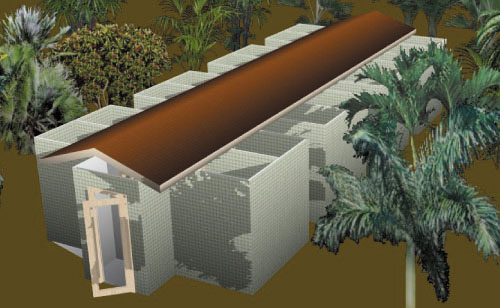
We are currently in the process of building an outdoor extension to accommodate the monkeys now living indoors in portables. Construction of the new extension is almost complete, and the Sanctuary is need of financial support.

Thank you to Jeff from Corners, Ltd. for coming to Maui, and volunteering your time to install the panels for the new enclosure. We would also like to thank Jim at Corners, Ltd. for providing us with a generous discount on the caging materials.

The building is now up! The caging materials have all been installed, and now we need to get electricity and water to the new enclosures. With the building stage nearly complete, it’s time to outfit the enclosures with plants, branches, and hammocks so the monkeys can move in!


We Need Your Help!

Please join with us in our life saving work. With your support, we can finish the new
outdoor enclosures for the monkeys now living indoors. Every contribution counts and is greatly appreciated.

Envisioning the New PPS Extension

Rescue Fund

A Rescue Fund will allow us to provide refuge for at risk animals needing to be brought to the Sanctuary immediately. Laboratories and pet owners often have deadlines for placement and may not contribute to the costs involved in getting the animal to Pacific Primate Sanctuary or provide for their housing and care. Your contributions will allow us to reach out to these monkeys and bring them to this safe haven.
Please send your tax-deductible donations to:


Pacific Primate Sanctuary
500-A Haloa Road
Haiku, HI 96708


Or donate on our website, www.pacificprimate.org using PayPal.


PPS PEOPLE in the SPOTLIGHT


Meet PPS Extern Mary Catherine

Mary Catherine recently moved to Maui with her husband, Brad, to become a full-time volunteer at Pacific Primate Sanctuary! Mary Catherine learned about Pacific Primate Sanctuary through a colleague who received an e-mail about our Internship program. After reading her application materials we knew that she would be an amazing addition to our Sanctuary Family. She is compassionate and selfless, and committed to helping primates.
Mary Catherine will be working much as an intern, but will be living off site. She has six years of experience with environmental enrichment and behavioral conditioning of Chimpanzees and monkeys in a laboratory setting. Mary Catherine is excited to be working in a Sanctuary, where the focus is truly on the wellbeing of the animals. We are thrilled to share our knowledge and experience with Mary Catherine, and also to learn from her.

In her application, Mary Catherine wrote:
I knew the Pacific Primate Sanctuary embodied everything I believe when I read the Deep Ecology page on your website. It captures the absolute essence of the core beliefs by which I define myself. The academic life I have lived thus far has handed me many tools, but it cannot provide me with the outlet to use them justly. My aims are to serve and advocate for the primates who do not share my freedoms, and I know my devotion can benefit your monkey families and help support your sanctuary’s mission. The Pacific Primate Sanctuary internship stands out among others because your vision is profound and far-reaching. The lives you are helping deserve loyal commitment, and your words and those of your volunteers clearly reflect a pledge to the animals and to the future of their species. I am eager to be involved in a sanctuary of this caliber.

Welcome Mary Catherine, we are so happy that you are part of
Pacific Primate Sanctuary’s Family


This Blog and its content is copyright of Pacific Primate Sanctuary, Inc.—
© Pacific Primate Sanctuary, Inc., 2009. All rights reserved.
Any redistribution or reproduction of part or all of the contents in any form is prohibited other than the following:
you may print or download to a local hard disk extracts for your personal and non-commercial use only
you may copy the content to individual third parties for their personal use, but only if you acknowledge the website as the source of the material
You may not, except with our express written permission, distribute or commercially exploit the content. Nor may you transmit it or store it in any other website or other form of electronic retrieval system.

Primate Update E-Newsletter, Vol. 2, Issue 7, Part 1

PPS PRIMATES in the SPOTLIGHT

Meet Little Bea

Little Bea is a White-tufted Eared Marmoset (Callithrix jacchus). She was born at Pacific Primate Sanctuary in August 2005, to Blanche and Ernesto. Little Bea’s mother, Blanche came from a research laboratory.

Blanche began to give birth during the day, which was unusual, as the marmosets typically have their babies at night. Over the rest of the day and evening Sanctuary volunteers watched as Blanche delivered her babies. Ernesto, the new father, nervously inspected his young. Hidden in the nest box were the two babies, Little Bea and Emilio, and as Ernesto peered in to investigate, he was suddenly latched on to by one of the babies. Instantly stunned and surprised, Ernesto then became the clinging post of two very new marmosets. Sadly, Blanche, passed away shortly after giving birth, leaving Little Bea without a mother. Ernesto quickly became “Super Dad” caring for Little Bea and her brother with the utmost attention. Sanctuary volunteers lent him a helping hand, providing the infants with the nourishment they needed.

Little Bea is now an adult, and has found a wonderful friend in Oona, another White-tufted Eared Marmoset. The two are currently living indoors, but will be moved into an outdoor enclosure as soon as the new Extension is complete!


NOTABLE NEWS

Xylophone enjoys the summer sun
Summer is officially here, and the rainy days are few and far between. The monkeys at Pacific Primate Sanctuary have been taking advantage of their outdoor enclosures to soak up the sunshine, and feel the gentle breeze on their fur. The beautiful weather has provided them with many opportunities for grooming in the sunlight, a favorite activity of many families! Fern and Xylophone, a pair of Cotton Top Tamarins given refuge last year from a college research laboratory, have particularly been enjoying their first summer out of doors. The warm weather has also been wonderful for Juas, an elderly Cotton Top Tamarin with poor mobility. His energy has increased, and he has been climbing on the mesh and branches with much greater agility this past month!


The Volunteers have been very creative in providing enrichment for the monkeys this month. Deidre and Daisy, a pair of Black-tufted Eared Marmosets, enjoyed foraging for treats that had been scattered throughout their enclosure. On another day, various feeders were stuffed leaves, and then treats were tucked inside. All the monkeys enjoyed digging through the feeders to find the goodies within.
Feeders filled with leaves                  Olivia, Lucian and Bianca foraging for treats


MEET MORE MONKEYS


Jason and Ira, a pair of Cotton Top Tamarin brothers, peer out from their soft sleeping house.


A White-Tufted Eared Marmoset hangs from a branch investigating an enrichment feeder in which special treats have been hidden in the leaves.


This Blog and its content is copyright of Pacific Primate Sanctuary, Inc.—
© Pacific Primate Sanctuary, Inc., 2009. All rights reserved.
Any redistribution or reproduction of part or all of the contents in any form is prohibited other than the following:
you may print or download to a local hard disk extracts for your personal and non-commercial use only
you may copy the content to individual third parties for their personal use, but only if you acknowledge the website as the source of the material
You may not, except with our express written permission, distribute or commercially exploit the content. Nor may you transmit it or store it in any other website or other form of electronic retrieval system.

Tuesday, July 6, 2010

Viola's 2nd Birthday


This Blog and its content is copyright of Pacific Primate Sanctuary, Inc.—
© Pacific Primate Sanctuary, Inc., 2009. All rights reserved.
Any redistribution or reproduction of part or all of the contents in any form is prohibited other than the following:
you may print or download to a local hard disk extracts for your personal and non-commercial use only
you may copy the content to individual third parties for their personal use, but only if you acknowledge the website as the source of the material
You may not, except with our express written permission, distribute or commercially exploit the content. Nor may you transmit it or store it in any other website or other form of electronic retrieval system.